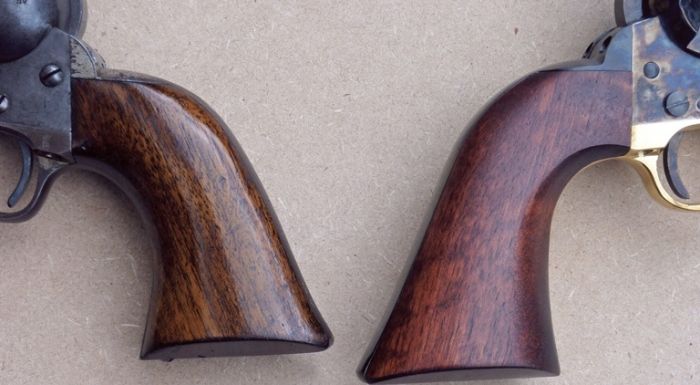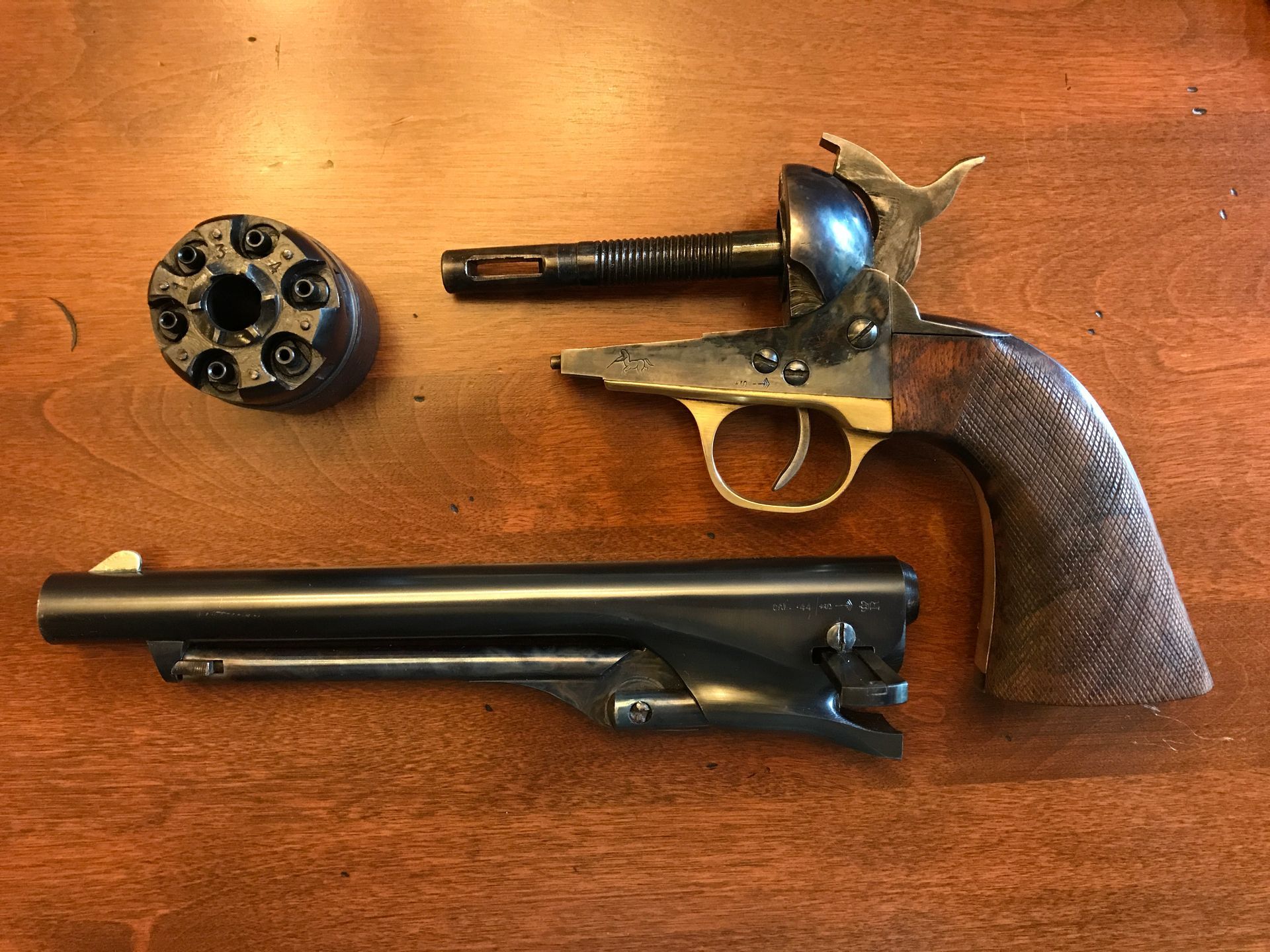
Confederate "Brass" Frame Revolver Metallurgy
A Technical Analysis of Alloy Composition
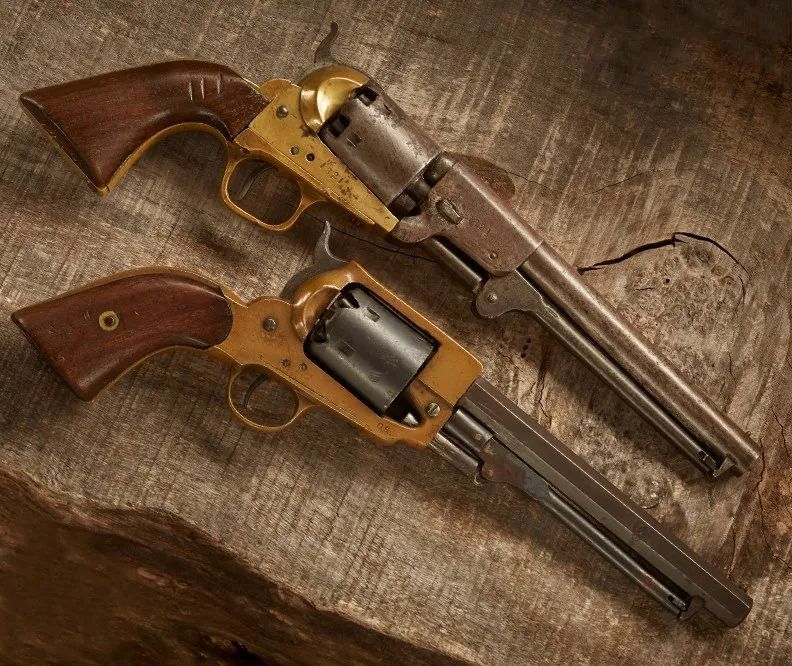
The Confederate revolvers commonly described as having "brass" frames represent one of the most misunderstood aspects of Civil War firearms metallurgy. While contemporary sources and modern collectors routinely refer to these frames as "brass," this designation is technically inaccurate. The Confederate States of America employed a sophisticated bronze alloy—variously termed "gunmetal," "red brass," or "gun metal bronze"—that differs substantially from the simple brass alloys (copper-zinc) used in modern reproduction firearms.[1][2]
The Gunmetal Alloy: Core Composition
Confederate manufacturers did not use true brass for revolver frames. Instead, they employed gunmetal, a ternary or quaternary bronze alloy consisting primarily of copper, tin, and zinc, with occasional additions of lead to improve casting characteristics.[2][1]
The typical composition of Confederate gunmetal followed established ordnance specifications that had evolved from cannon metallurgy:
· Copper: 80-88%
· Tin: 8-15%
· Zinc: 2-5%
· Lead: 0-2.5% (when added)[3][1][2]
The most commonly cited formulation approximates 88% copper, 10% tin, and 2% zinc, which closely matches British Admiralty gunmetal specifications. The U.S. Ordnance formula specified 88% copper, 8% tin, and 4% zinc. Confederate manufacturers appear to have worked within this range, though material shortages forced considerable variation.[4][1][2][3]
The Lead Addition: Enhanced Castability
A critical but often overlooked component was lead, added specifically to improve the fluidity of molten metal during casting. Confederate manufacturers struggling with primitive foundry conditions used lead to compensate for inadequate casting equipment and inexperienced workers. The typical lead-enhanced formulation consisted of:[1][2]
· Copper: 86%
· Tin: 9.5%
· Lead: 2.5%
The addition of lead served two purposes: it increased the metal's flow characteristics when molten, enabling better mold filling and sharper detail reproduction, and it improved machinability after casting. This explains why Confederate sources frequently referenced lead shortages—not only for bullets and cartridges, but also for frame casting.[5][6][1]
Material Sourcing and Compositional Variation
The romanticized narrative of Confederate church bells being melted for pistol frames contains substantial truth. Church and plantation bells provided a readily available source of bronze, though their composition differed from ideal gunmetal specifications.[7][8][9][1]
Bell bronze (bell metal) typically consists of:
· Copper: 78%
This higher tin content (22% versus 8-15%) made bell bronze considerably harder and more brittle than optimal gunmetal. Confederate foundries addressed this by adding copper to the melt to adjust the alloy closer to standard gunmetal specifications. However, material shortages meant that Confederate manufacturers often worked with whatever bronze sources were available, resulting in frames that varied from yellowish (higher zinc content) to reddish (higher copper content) depending on the specific batch.[14][15][9][10][1][2]
Confederate bronze cannons, particularly the ubiquitous Napoleon 12-pounder field guns, used a bronze composition of approximately:
· Copper: 90%
This cannon bronze, while closer to ideal gunmetal than bell metal, still required compositional adjustment for revolver frames. The capture of the Ducktown copper mines near Chattanooga by Union forces in November 1863 severely impacted Confederate bronze production, forcing increased reliance on recycled sources.[18][17][10]
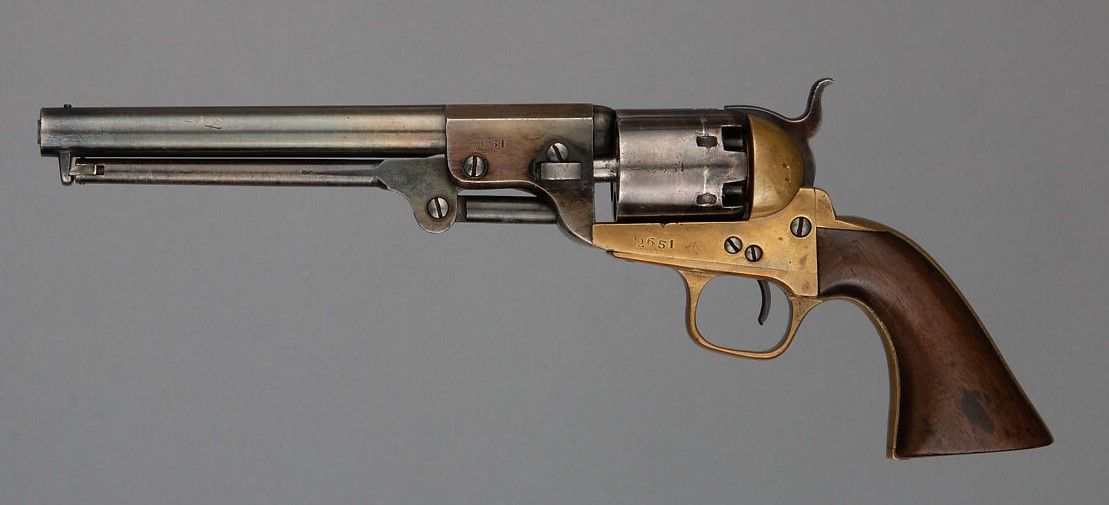
The most prolific Confederate revolver manufacturer, Griswold & Gunnison of Griswoldville, Georgia, produced approximately 3,600 revolvers between 1862 and 1864. Their frames exhibit considerable color variation, from yellow-bronze to reddish hues, reflecting the inconsistent source material blended in their foundry pots.[19][20][15][9][14][7][1]
The Griswold factory explicitly relied on church bell bronze from Macon, Georgia, mixed with other available copper sources. The resulting frames display the characteristic color inconsistency noted by contemporary inspectors and modern collectors. Original Griswold frames often appear more reddish than reproduction brass frames due to excess copper content in the alloy.[15][14][7][1]

Spiller & Burr revolvers, produced first in Atlanta and later at the Confederate government facility in Macon, Georgia (total production: 1,451 units), initially featured brass frames with silver electroplating. However, by mutual agreement between the manufacturers and the Richmond Arsenal, the silver plating was discontinued in January 1863 as it proved too thin and wore off unevenly.[21][14][15][5]
Later production Spiller & Burr revolvers reportedly employed a valve bronze alloy composed of:
· Copper: (predominant)
· Zinc: (secondary)
· Lead: (significant addition)
· Nickel: (trace amounts)[5]
This valve bronze formulation, designed to enhance strength and casting properties, represents an innovative attempt to optimize the alloy for the specific stresses imposed by revolver operation. The frame composition varies from yellow to rose coloration depending on copper content, similar to Griswold & Gunnison production.[15][5]

Schneider & Glassick:
Short of a lab report on one of the handful of surviving guns, the Schneider & Glassick story is more about type of alloy than exact percentages. The best we can do is identify the family of “gunmetals” they almost certainly used and how those differed from modern yellow‑brass reproductions.
There is no published, instrument‑grade composition for an original S&G frame.
Surviving documentation and comparative evidence indicate that the brass‑frame examples were cast from Confederate gunmetal / red‑brass bronzes—high‑copper Cu–Sn–Zn (often with some Pb)—rather than from simple Cu–Zn yellow brass.
Any specific percentage breakdown you see in print is an extrapolation from general 19th‑century gunmetal practice and from analyses of other Confederate and contemporary bronze‑frame arms, not from a measured Schneider & Glassick specimen.
Leech & Rigdon / Rigdon-Ansley
Contrary to popular assumption, Leech & Rigdon revolvers (total production estimated at 3,600 units) predominantly featured iron frames, not brass. Only the backstraps and small, rounded trigger guards were manufactured from brass. This represents a significant exception to the "Confederate brass frame" stereotype and demonstrates that when iron was available, it remained the preferred material.[22][23][24]
Dance Brothers revolvers, manufactured in Columbia, Texas, primarily used steel frames with brass trigger guards and backstraps, similar to the Leech & Rigdon pattern. The .44-caliber Dance revolvers followed Colt Dragoon dimensions but were lighter, and most examples feature steel frames rather than the brass construction often assumed for Confederate manufacturers.[25][26][27]
The few brass components (trigger guards and backstraps) on Dance revolvers were true brass or bronze castings, but the frames themselves were steel or iron when materials permitted.[27][25]
Comparison: Original Confederate Alloys vs. Modern Reproductions
Modern Italian reproduction "brass frame" Confederate revolvers differ fundamentally from original gunmetal frames in both composition and properties.
· Composition: Copper-tin-zinc bronze (80-88% Cu, 8-15% Sn, 2-5% Zn, 0-2.5% Pb)
· Color: Yellow-bronze to reddish, depending on copper content
· Hardness: Significantly harder than modern brass
· Tensile strength: 221-310 MPa[28]
· Casting: Excellent castability with period foundry technology[1][2]
Modern Italian Reproduction "Brass"
· Composition: Simple brass (56% Cu, 44% Zn, 0% Sn)[2][1]
· Color: Bright yellow brass
· Hardness: Substantially softer than gunmetal bronze
· Properties: Inferior strength and durability under firing stress[29][1][2]
X-ray fluorescent analysis of a Uberti reproduction Henry rifle frame revealed 56% copper and 44% zinc with no trace of tin—true brass rather than gunmetal bronze. This stark difference explains why original Confederate revolvers performed adequately in combat service while modern brass-framed reproductions suffer from frame stretching, arbor pin migration, and recoil shield battering when fired with full-power loads.[29][1][2]
Historical Winchester Model 1866 Analysis
Analysis of an original Winchester Model 1866 "Improved Henry" frame from 1868 provides valuable comparative data, as these firearms used similar gunmetal alloys:
· Copper: 83%
· Tin: 14.5%
· Zinc: 2%
This composition falls squarely within the Confederate gunmetal range and demonstrates the standard industrial practice of the period for bronze firearm frames. The Henry and Improved Henry rifles were never referred to as having "bronze frames" despite using bronze alloy, illustrating the linguistic confusion surrounding these materials.[1][2]
Manufacturing Rationale: Why Bronze Instead of Iron?
Confederate manufacturers adopted bronze frames not solely due to iron shortages, but also because of significant manufacturing advantages in their limited industrial environment.[31][32][33][34]
Bronze casting offered several critical benefits:
1. Lower melting point: Bronze melts at approximately 900-950°C, compared to 1,200-1,300°C for iron smelting[33][35][36]
2. Superior castability: Bronze flows readily when molten, filling complex mold details more completely[35][33]
3. Reduced equipment requirements: Bronze casting required less sophisticated furnaces and foundry equipment[36][31][33]
4. Faster production: Cast bronze frames eliminated extensive milling and forging operations required for iron frames[34][31]
Even when iron was available, bronze frames could be produced more rapidly by manufacturers with limited machine shop capacity and unskilled labor. Griswold & Gunnison, for instance, achieved consistent production of 135 revolvers per month (approximately five per day) once adequate bronze supplies were secured through the church bell campaign.[32][8][9][31][34]
The persistent shortage of quality steel forced Confederate manufacturers to use "twisted iron" for cylinders instead of steel. This process involved heating and physically twisting iron bars to theoretically close pores and improve tensile strength, though metallurgist W.W. Greener later noted this actually embrittled the metal. Barrels were similarly made from wrought iron rather than steel when steel was unavailable.[20][37][38][14]
The Confederacy possessed adequate iron ore deposits—sufficient for casting cannons and railroad iron—but lacked the industrial infrastructure to convert this ore into the high-grade steel required for small arms components. Bronze casting thus represented a pragmatic accommodation to industrial limitations rather than absolute material scarcity.[31][33][34]
Terminology and Historical Usage
The term "brass" when applied to Confederate revolvers represents a colloquial simplification rather than precise metallurgical designation. Period sources used several overlapping terms:
· Gunmetal: Technical ordnance term for copper-tin-zinc bronze alloy[4][28][2][1]
· Red brass: American vernacular for gunmetal bronze, particularly with higher copper content[39][4][2][1]
· Yellow bronze: Bronze with higher zinc content, appearing more yellow[9][14]
· Gun metal bronze: Combined term emphasizing bronze nature of the alloy[9][1]
· Brass: Colloquial term, technically incorrect but widely used[14][1]
Confederate ordnance inspectors and manufacturers understood they were working with bronze alloys, not brass, though contemporary correspondence and contracts sometimes used "brass" as convenient shorthand. Modern collectors and historians have perpetuated this imprecise terminology, leading to widespread confusion about the actual metallurgy involved.[30][14][15][9][2][1]
Metallurgical Properties and Performance
The gunmetal bronze used in Confederate revolvers possessed mechanical properties intermediate between true brass and steel:
Gunmetal Bronze Properties:
· Tensile strength: 221-310 MPa[28]
· Brinell hardness: 65-74[28]
· Specific gravity: 8.7[28]
· Corrosion resistance: Excellent, particularly against atmospheric corrosion[40][28]
· Wear resistance: Inferior to phosphor bronze, adequate for revolver frame service[41]
These properties made gunmetal suitable for revolver frames when proper design considerations were observed. The Spiller & Burr design, for instance, strengthened the frame by eliminating the loading aperture slot and thickening the front section, specifically to compensate for bronze's lower tensile strength compared to iron.[15][5]
The recoil stresses in a .36-caliber Navy-pattern revolver with period-correct 17-20 grain powder charges remained within gunmetal's working limits, though the softer bronze gradually work-hardened at stress points (particularly the recoil shield) over extended firing. Original Confederate revolvers show evidence of this work-hardening and gradual deformation at high-stress points, but rarely catastrophic failure.[29][15][1]
Confederate "brass frame" revolvers were manufactured from gunmetal bronze—a sophisticated ternary or quaternary alloy of copper (80-88%), tin (8-15%), zinc (2-5%), and sometimes lead (0-2.5%)—rather than the simple copper-zinc brass suggested by popular terminology. This gunmetal formulation derived from established ordnance bronze specifications developed for cannon casting and represented the standard industrial practice for non-ferrous firearm components during the mid-19th century.[3][4][2][1]
Material sourcing from church bells, cannons, and other recycled bronze objects introduced significant compositional variation, resulting in frames ranging from yellow to reddish in color depending on the relative proportions of copper, tin, and zinc in any particular casting batch. Confederate manufacturers pragmatically worked with available materials, adjusting alloy compositions as necessary to achieve functional results despite inconsistent supply chains.[10][14][9][15][1]
The adoption of bronze frames reflected not only strategic material shortages but also rational manufacturing decisions given the South's limited industrial infrastructure. Bronze casting enabled faster production with less sophisticated equipment and labor compared to the forging and extensive machining required for iron frames. Modern reproduction "brass frame" revolvers using simple copper-zinc brass (56% Cu, 44% Zn) bear little metallurgical resemblance to original Confederate gunmetal frames and exhibit substantially inferior mechanical properties under firing stress.[33][34][31][2][1]
Understanding the true composition of Confederate revolver frames—gunmetal bronze rather than brass—corrects a persistent historical misconception and illuminates the sophisticated metallurgical knowledge applied by Southern ordnance officers and manufacturers working under extraordinary constraints.[3][4][2][1]
FOOTNOTES
1. https://www.n-ssa.net/vbforum/showthread.php/9010-Brass-Framed-Revolvers-Myths-and-Myths-Part-4
2. https://www.n-ssa.net/vbforum/archive/index.php/t-9010.html
3. http://firearmshistory.blogspot.com/2014/10/metals-used-in-firearms-vi.html
4. https://en.wikipedia.org/wiki/Gunmetal
5. https://www.americanrifleman.org/content/a-look-back-at-the-spiller-burr-revolver/
6. https://www.adinathextrusion.com/copper-alloy-ingots/gun-metal-red-brass-bronze/rg5.html
7. https://www.metmuseum.org/art/collection/search/24847
8. https://www.n-ssa.net/vbforum/showthread.php/8981-Brass-Framed-revolvers-Myths-and-Realities-Part-2
10. https://scholarworks.iu.edu/journals/index.php/iusburj/article/download/19818/25895/43938
11. https://www.belmontmetals.com/product/bell-metal/
12. https://en.wikipedia.org/wiki/Bell_metal
13. https://rotaxmetals.net/bronze-sheet-metal-facts-the-case-of-the-cracked-bell/
15. https://www.littlegun.info/arme americaine/revolver confedere/a revolver confedere spiller gb.htm
16. https://peteskillman.com/2013/06/civil-war-artillery-bronze-guns/
17. https://en.wikipedia.org/wiki/M1841_6-pounder_field_gun
18. https://www.facebook.com/groups/gettysburgwitnesstrees/posts/373802295499033/
19. https://www.historynet.com/confederate-brass-pistols/
20. https://www.youtube.com/watch?v=e1zVDRRUIew
21. https://www.n-ssa.net/vbforum/showthread.php/8970-Brass-Frame-Revolvers-Realties-and-Myths-Part-1
24. http://www.littlegun.info/arme americaine/revolver confedere/a revolver confedere leech gb.htm
26. https://www.youtube.com/watch?v=P-Rpeqltmuk
27. http://www.littlegun.info/arme americaine/revolver confedere/a revolver confedere dance gb.htm
28. https://stokesleymetalsltd.co.uk/non-ferrous-metals/gun-metal-red-brass/
29. https://www.youtube.com/watch?v=f3ITm7AkGx4
30. https://www.thehighroad.org/index.php?threads%2Fbrass-frame-revolvers.900146%2F
32. https://www.muzzleloadingforum.com/threads/curiosity-regarding-confederate-brass-revolvers.20695/
33. https://americanlongrifles.org/forum/index.php?topic=31636.0
34. https://www.atlantacutlery.com/small-arms-in-the-civil-war
35. https://www.gammafoundries.com/255-brass-or-bronze-which-is-better-for-casting-services/
37. https://www.forgottenweapons.com/griswold-gunnison-the-best-confederate-revolver-makers/
38. https://www.forgottenweapons.com/james-d-julia-confederate-spiller-burr-revolver-presentation/
39. https://www.muzzleloadingforum.com/threads/brass-vs-steel-frame-revolvers.101218/page-2
40. https://www.britannica.com/technology/gunmetal
41. https://www.totalmateria.com/en-us/articles/gunmetals-and-leaded-bronzes/
42. https://www.ccsutlery.com/store/civil-war-weapons-revolvers-pistols.html
Social Media