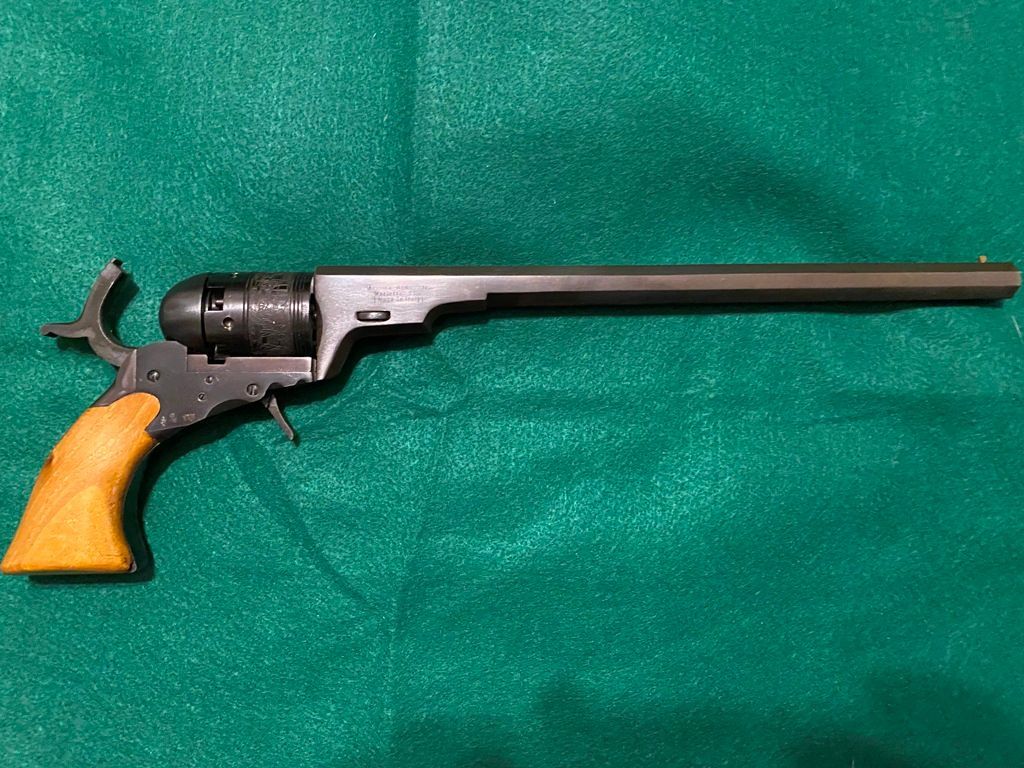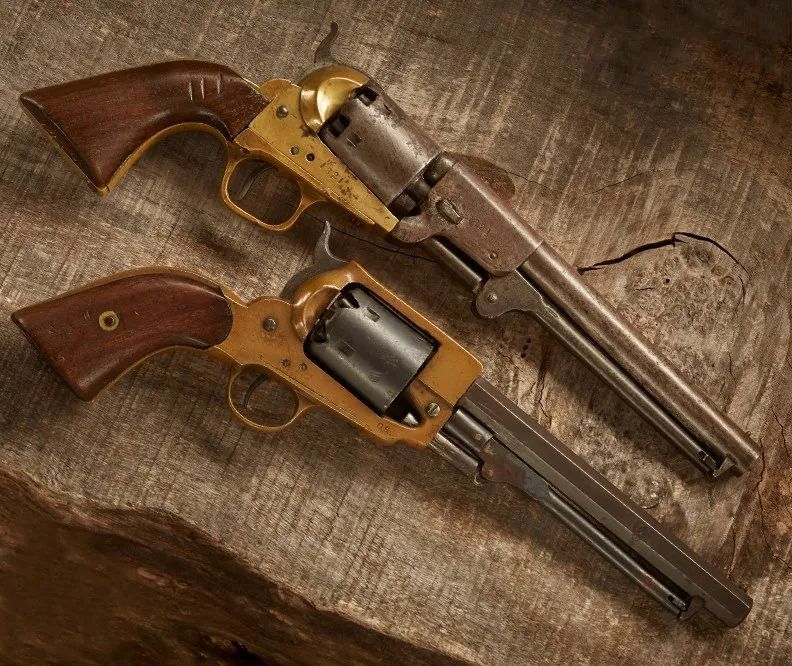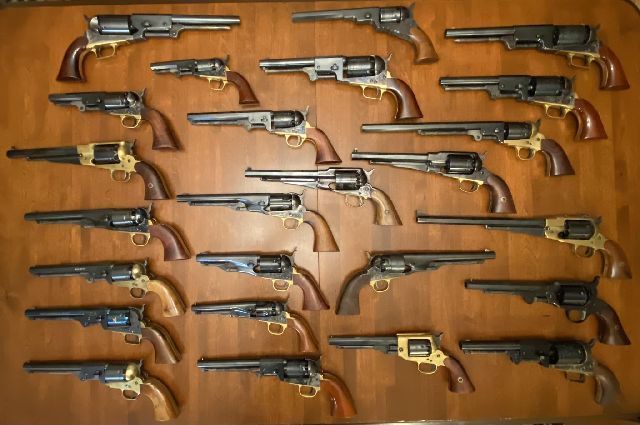
COLT PERCUSSION REVOLVERS - 1851/1860/1861/1862 Frame & Water Table Comparisons
1851 Navy · 1860 Army · 1861 Navy · 1862 Pocket Navy
Frame anatomy · Water table steps · Cylinder clearance · Loading lever variants · Key dimensions
Introduction
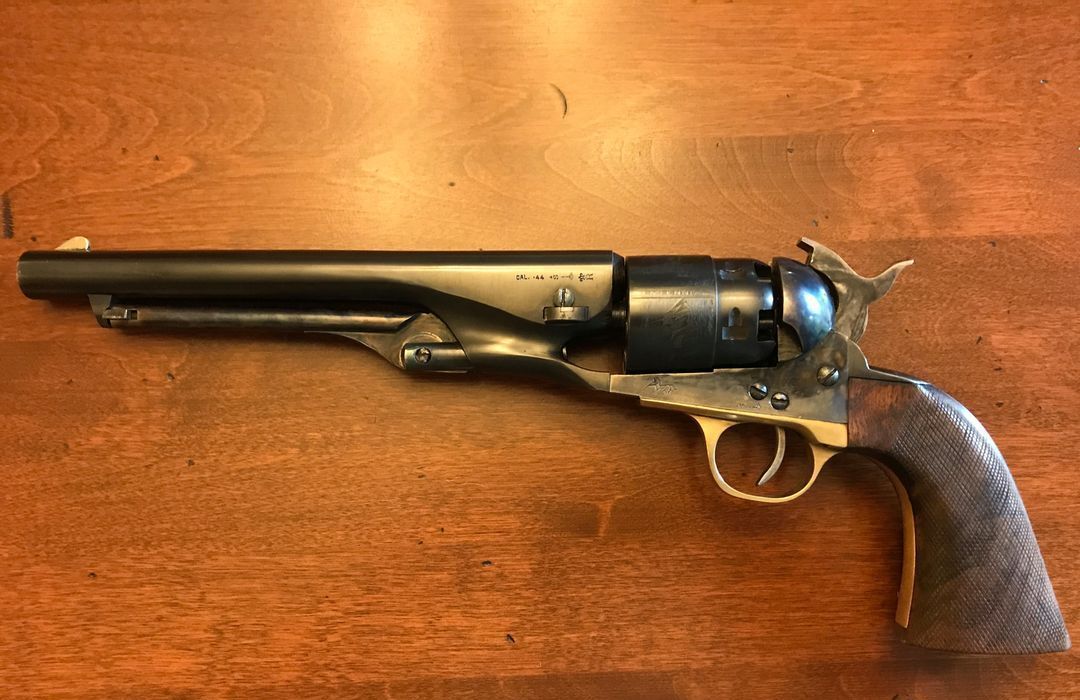
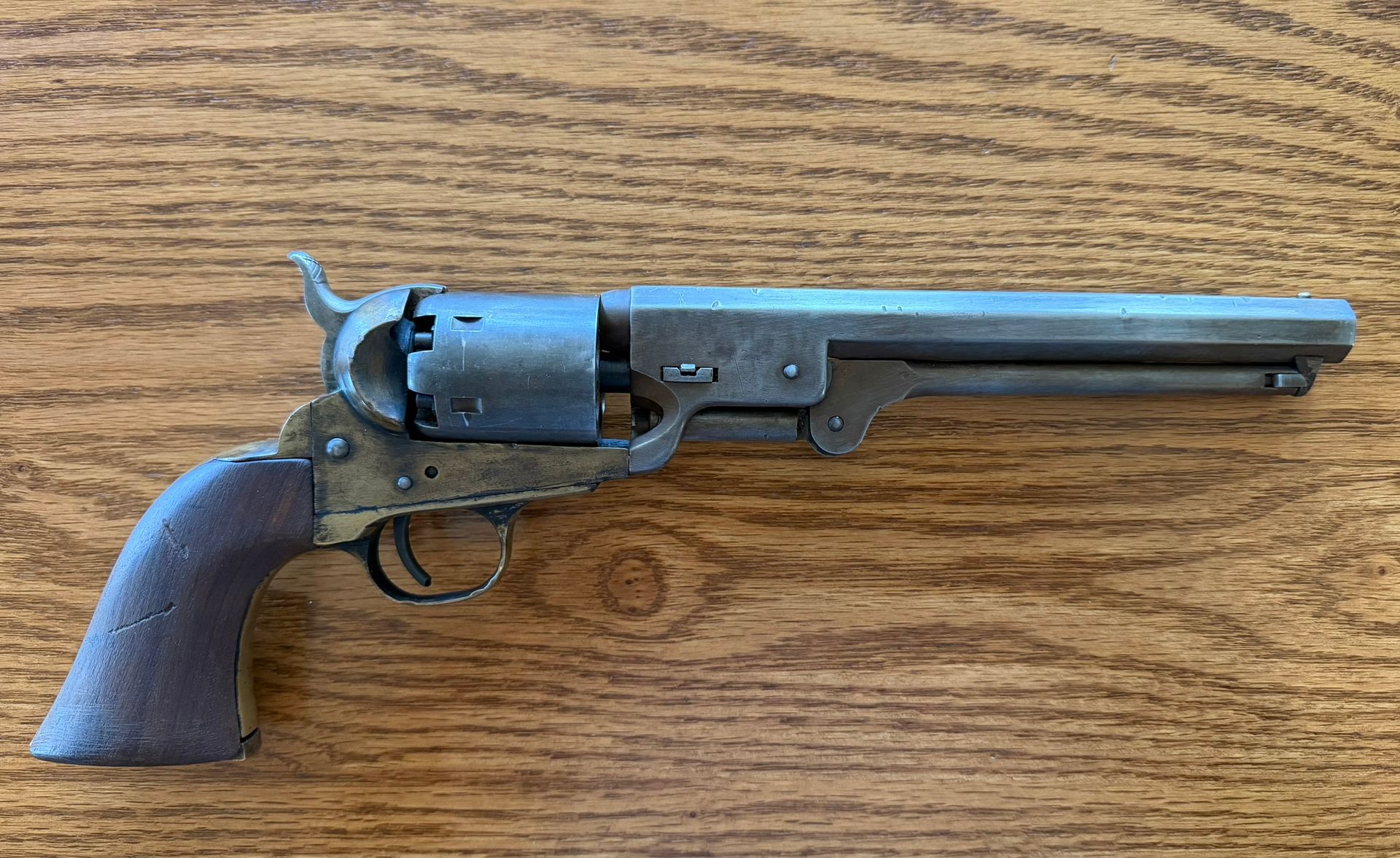
Between 1851 and 1873, Colt's Patent Fire Arms Manufacturing Company produced a sequence of cap-and-ball revolvers whose frame architecture embodies one of the most instructive evolutionary arcs in American gunmaking. Four models define that arc with particular clarity: the 1851 Navy, the 1860 Army, the 1861 Navy, and the 1862 Pocket Navy. Taken together they document how a single frame pattern — the slender, iron Navy bar developed in Hartford for the Mexican War era — was progressively adapted to meet demands for greater bore diameter, improved loading mechanisms, and reduced carrying weight, without abandoning the tooling investment already in place.
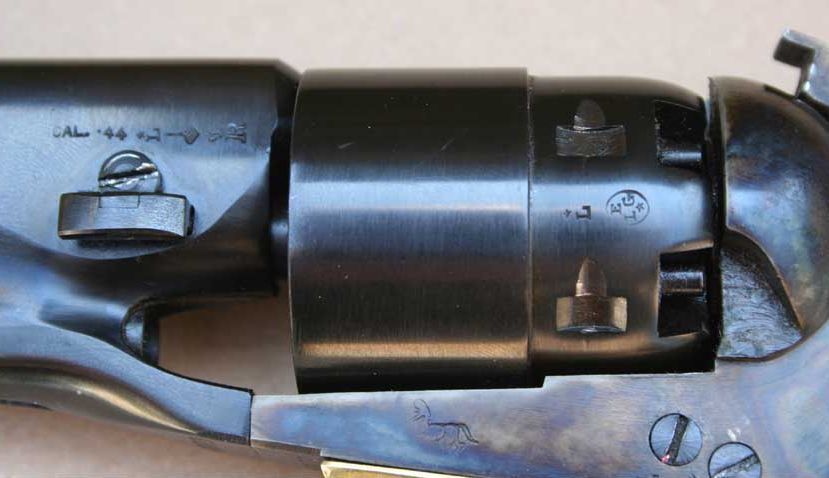
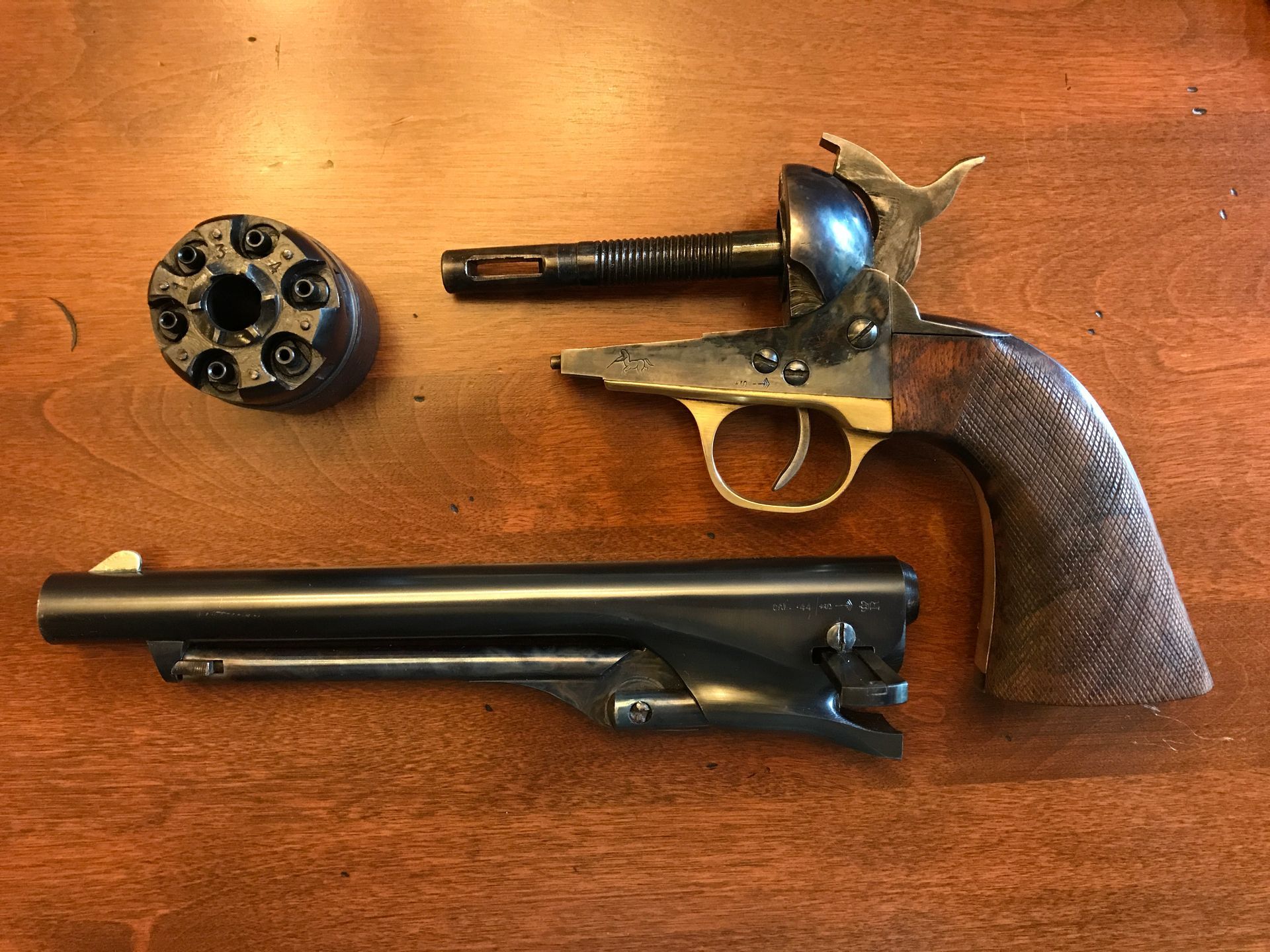
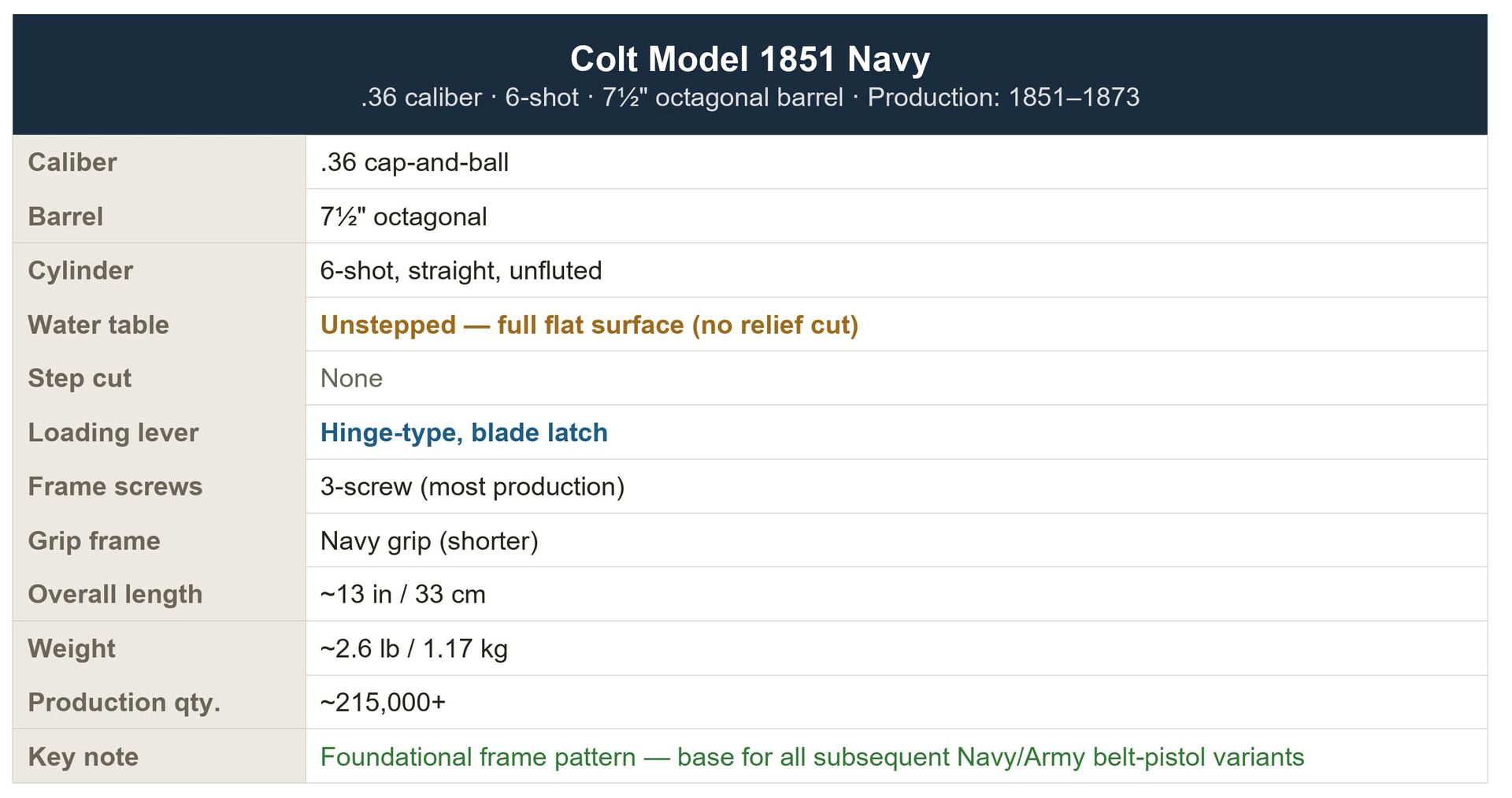
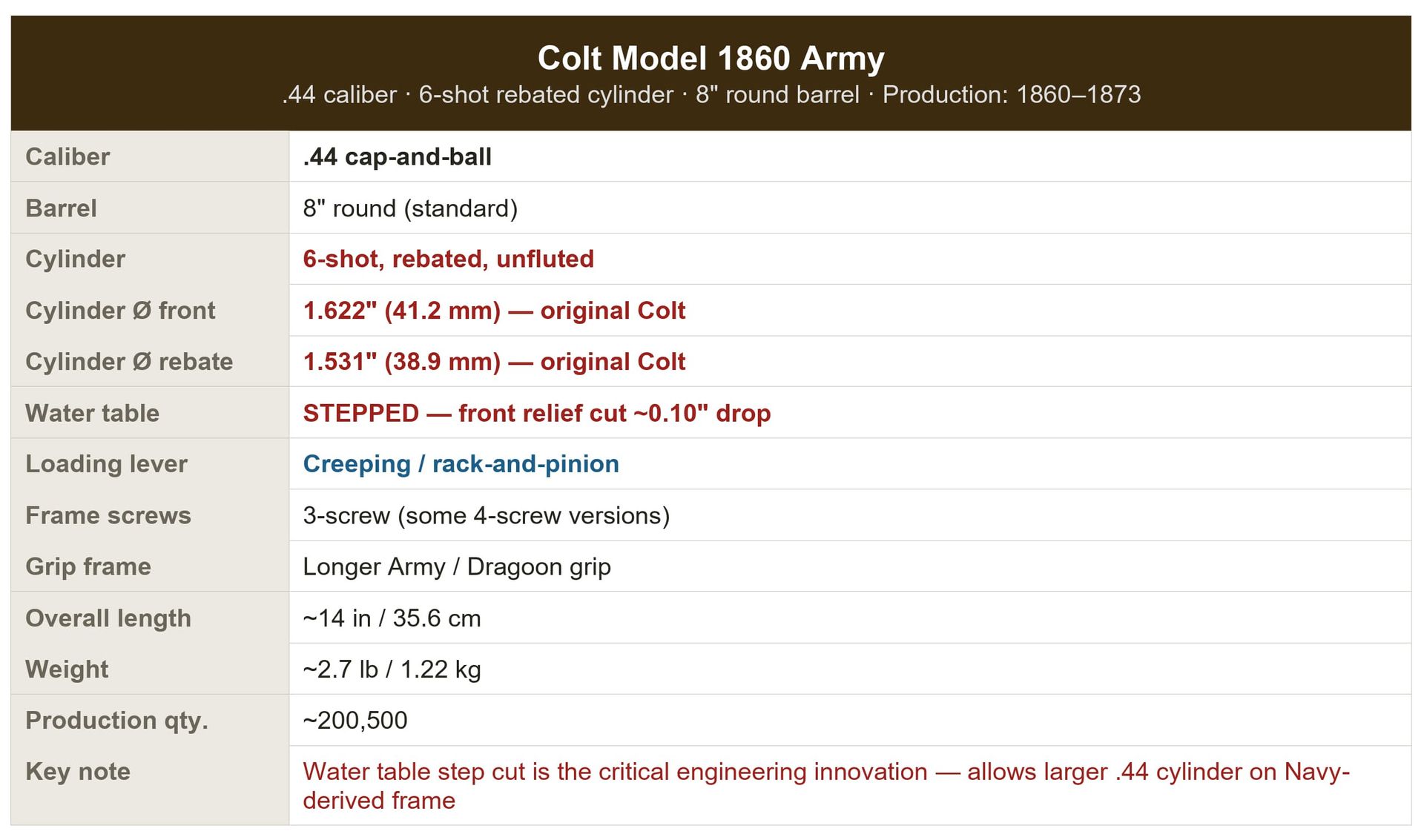
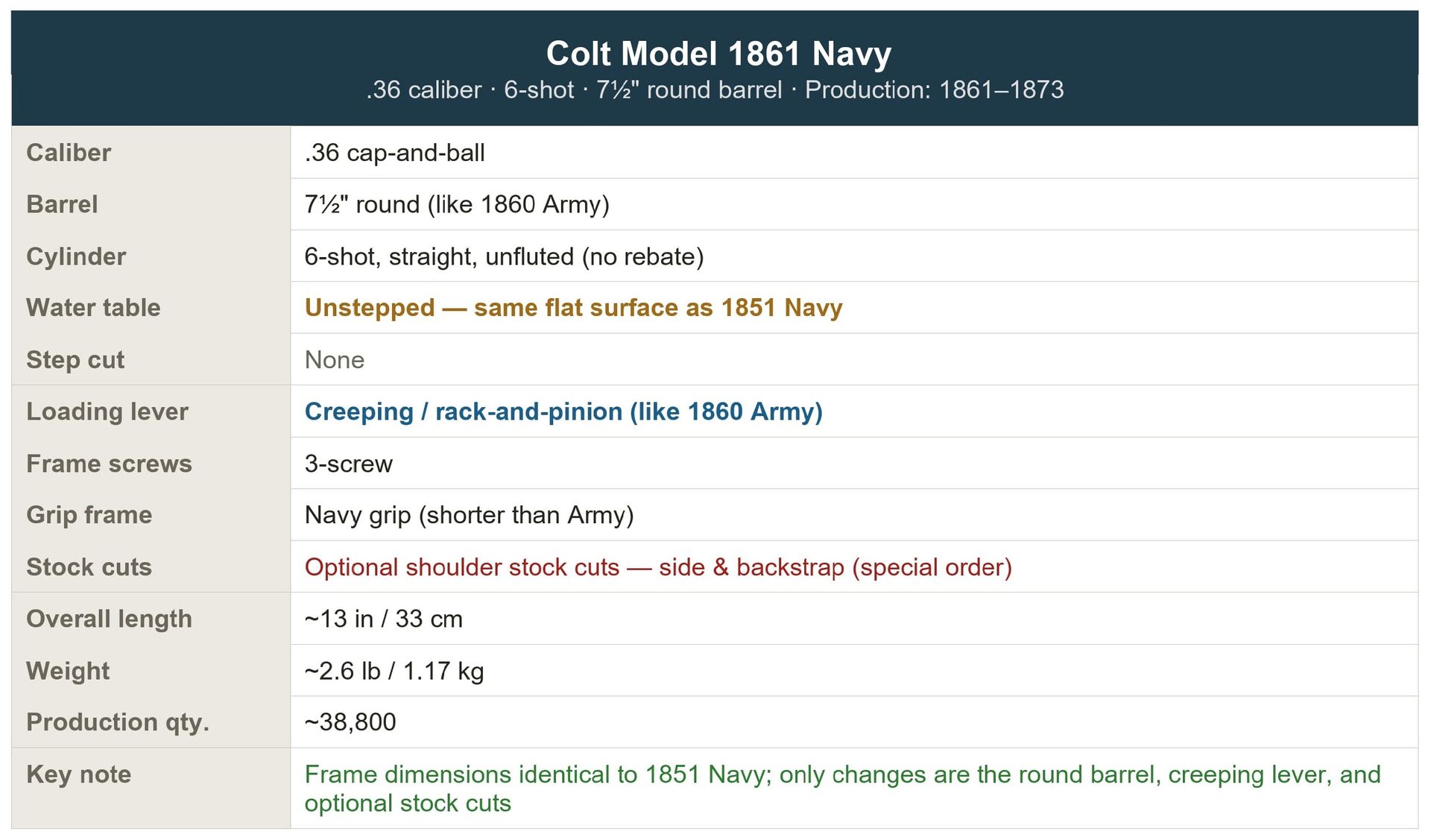
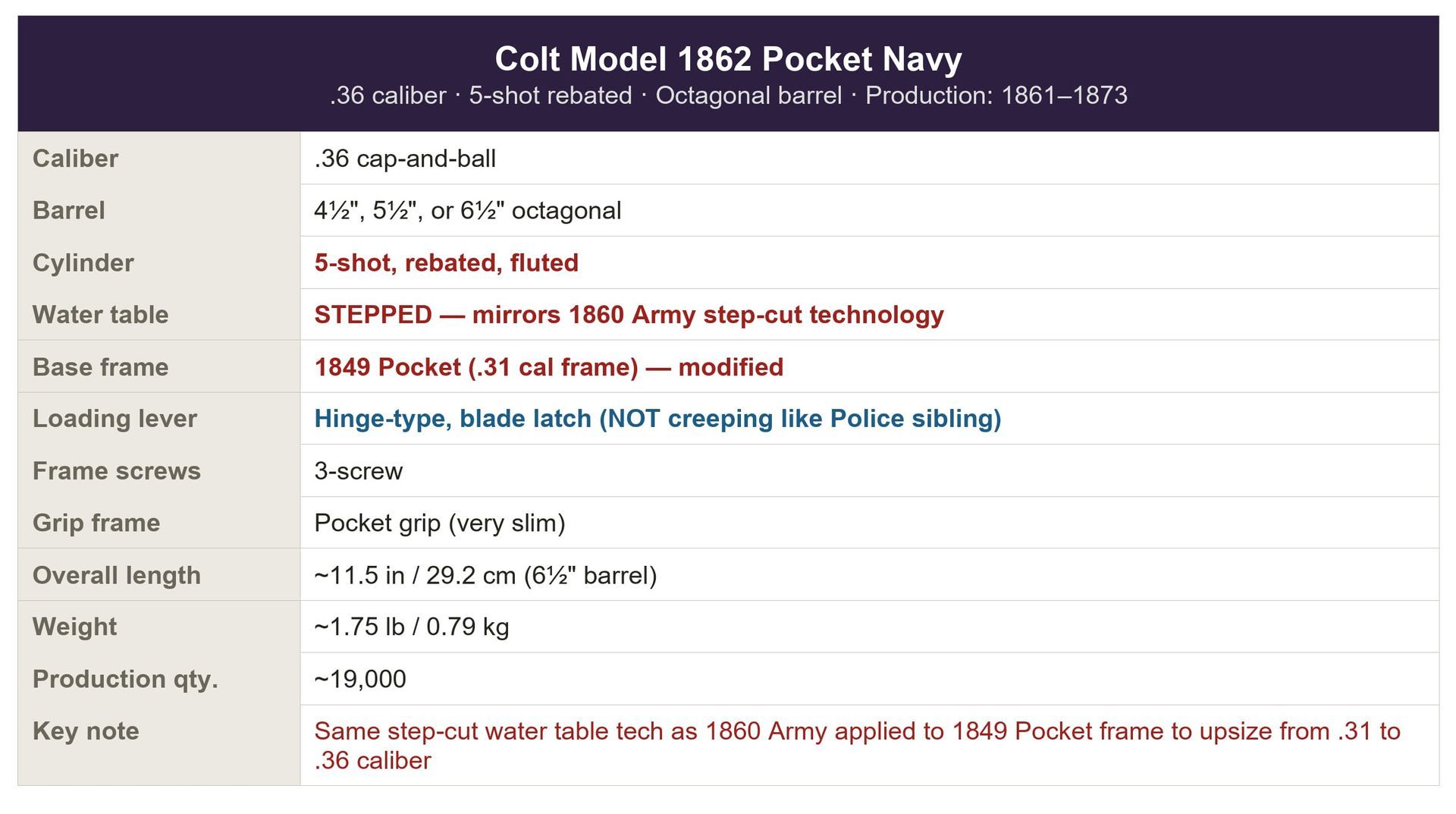
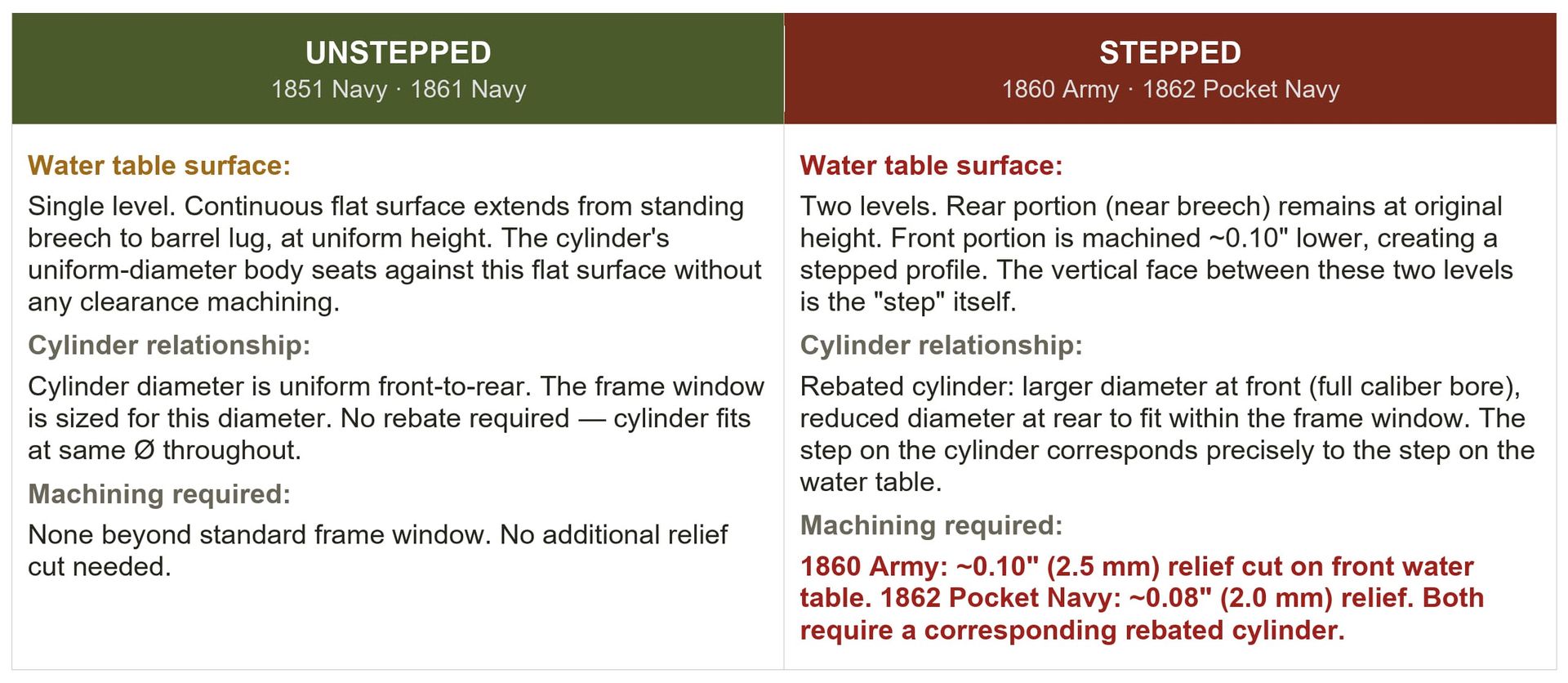
The central structural feature under examination here is the water table: the horizontal surface machined into the top of the frame bar, forward of the standing breech, on which the barrel's lower flat or lug seats. On the 1851 and 1861 Navy the water table is a single, uninterrupted plane. On the 1860 Army and 1862 Pocket Navy it is stepped — a precision relief cut, roughly 0.10" on the Army and 0.08" on the Pocket Navy, that drops the forward portion of that surface to clear the larger-diameter front section of a rebated cylinder. That step, modest in scale and invisible to a casual observer, is the mechanical key that allowed Colt to chamber a .44-caliber ball in a frame originally designed around a .36-caliber cylinder without enlarging the frame window.
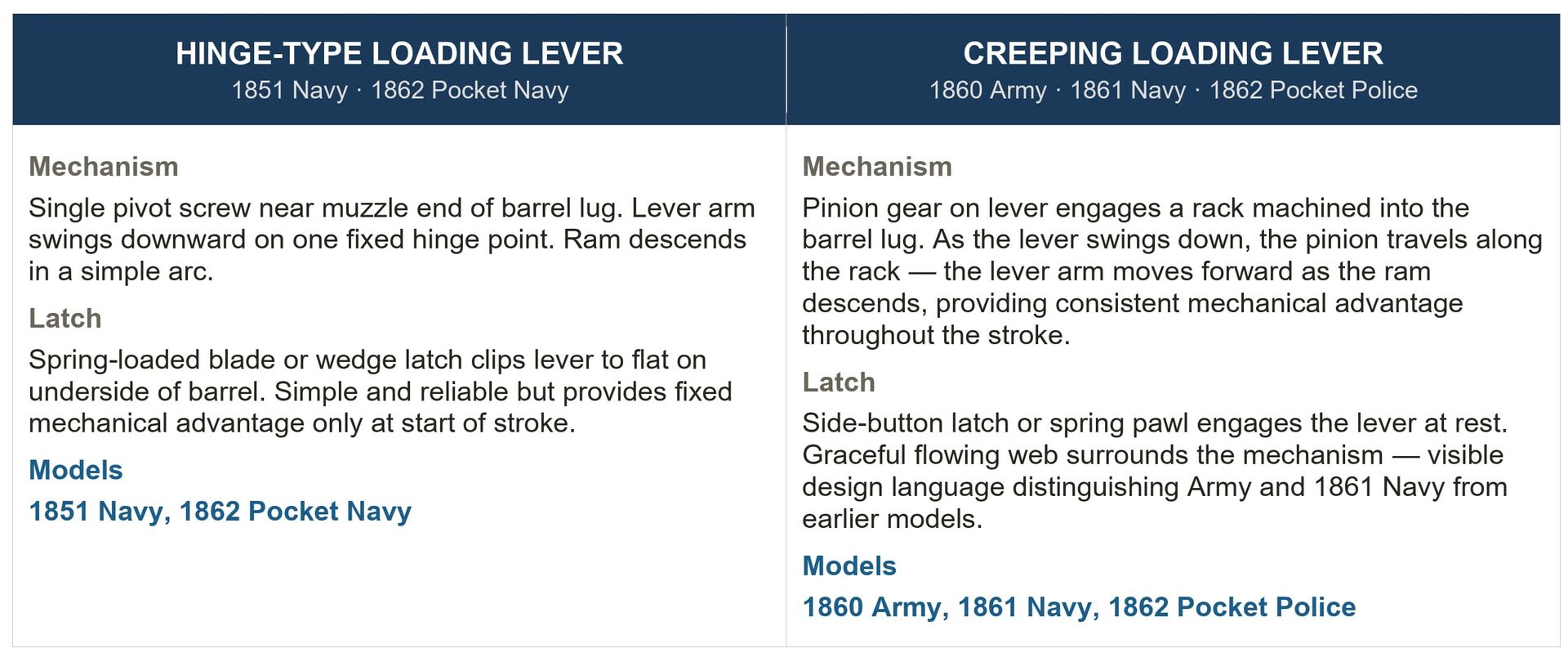
The loading lever underwent its own independent evolution across the same period. The 1851 Navy used a hinge-type lever retained by a blade latch — simple, adequate for field use, but prone to dropping free under recoil and jamming the cylinder. By 1860 the creeping rack-and-pinion lever, already proven on the Dragoon, was adopted for the Army model and carried forward to the 1861 Navy. The 1862 Pocket Navy, however, reverted to the hinge pattern, reflecting the small frame's dimensional constraints and the civilian market's tolerance for the lighter-duty mechanism.
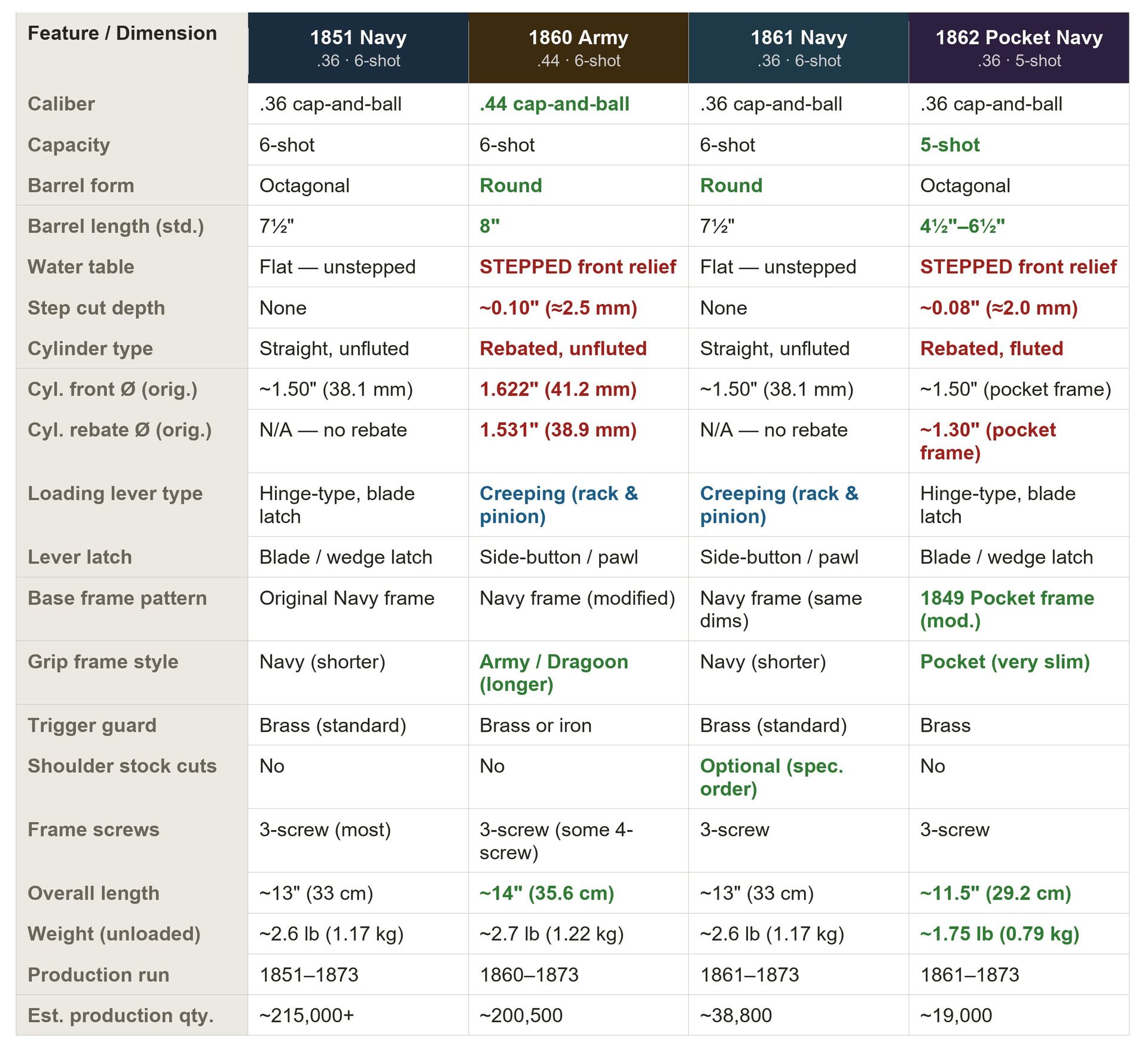
This reference guide documents all four models across twenty structural and dimensional parameters: water table type and step depth, cylinder geometry and rebate dimensions, loading lever pattern, barrel profile and length, grip frame configuration, overall length, and weight. A separate frame lineage table maps the genealogical relationships — which models share the same frame pattern, which dimensions were carried over unchanged, and where deliberate modifications were introduced. Dimension data derives from primary measurement records, period documentation, and published research on original production specimens; deviations found in modern Italian replicas by Pietta and Uberti are noted where they affect part compatibility or assembly dimensions.
Readers comparing original Colt production hardware to contemporary replicas should treat the nominal dimensions in this guide as a baseline against which individual specimens vary. Nineteenth-century manufacturing tolerances were hand-fitted to a degree that modern production does not replicate, and Italian makers have made documented changes to grip frames, cylinder bores, and lever geometry that can affect interchangeability. Where those deviations are significant they are called out explicitly in the relevant sections.
Individual Model Specifications
Detailed per-model specifications including water table type, cylinder geometry, and loading lever system
Water Table Anatomy
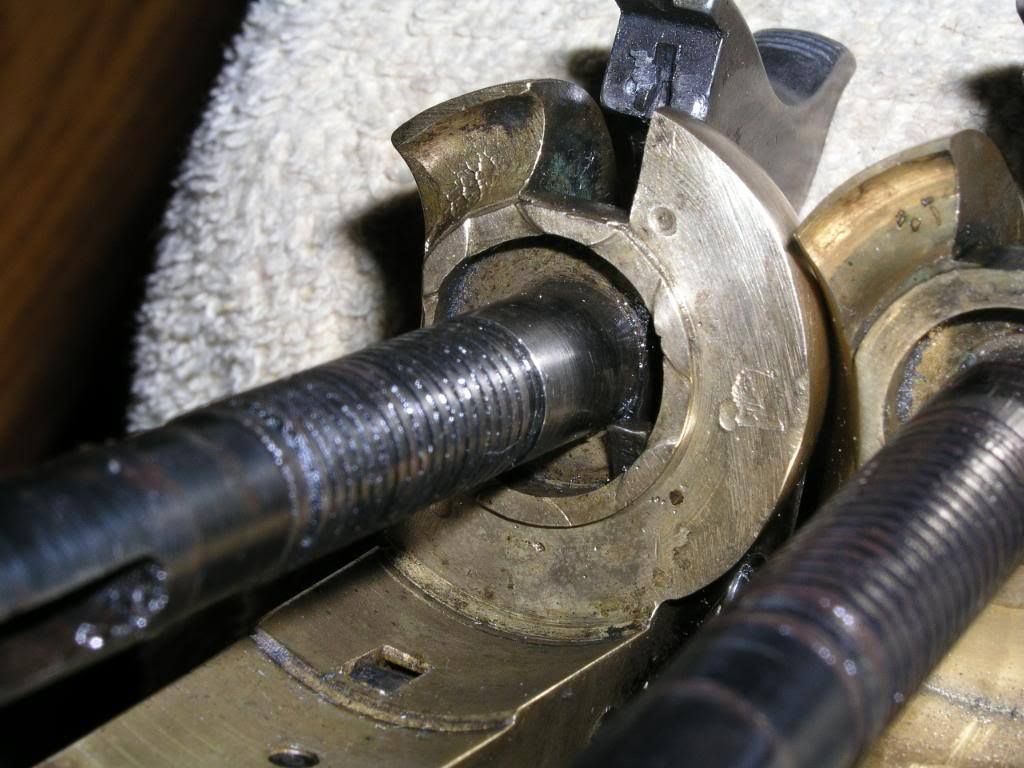
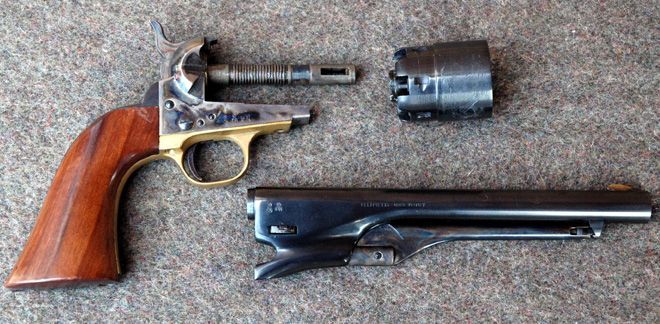
The water table is the flat surface of the frame beneath the cylinder. Unstepped models have a single flat surface; stepped models have a two-level surface with a machined relief cut at the front to accommodate a larger-diameter rebated cylinder.
Loading Lever Variations
Two distinct loading lever systems were used across these four models. The pattern follows design generation, not caliber.
Frame Lineage & Derivation
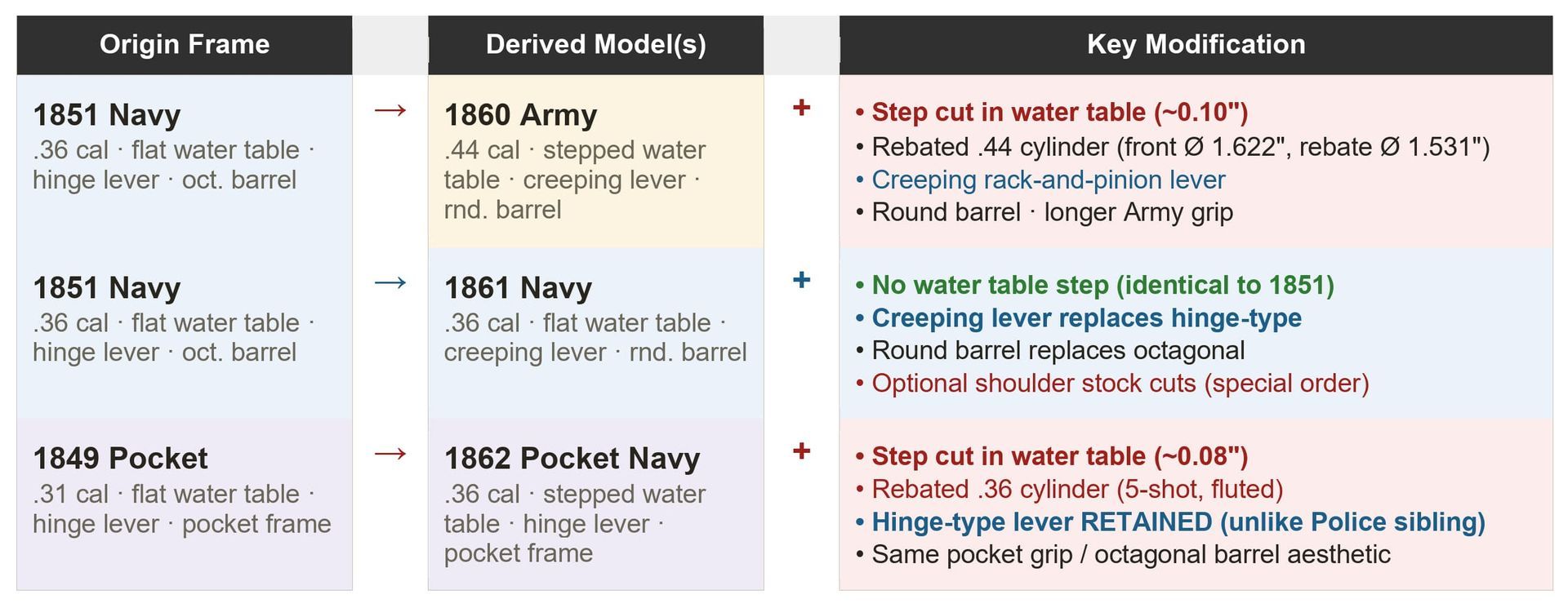
Colt's manufacturing philosophy used minimal additional machining — primarily the water table step cut — to adapt proven frame patterns for new calibers, allowing rapid model development from existing tooling
Master Comparison Table
All four models compared across 20 structural and mechanical dimensions. Bold colored values indicate notable departures from the baseline 1851 Navy pattern.
Technical Notes & Researcher Annotations
Frame Interchangeability
The 1851 Navy, 1860 Army, and 1861 Navy all share the same foundational "belt pistol" frame dimensions. A .36 Navy cylinder and barrel will generally mount on a 1860 Army frame due to shared tolerances — reflecting Colt's assembly-line manufacturing philosophy.
The water table step is the only material machining difference between 1851 and 1860 Army frame forgings. All other geometry is shared.
The Step Cut — Engineering Logic
When Colt enlarged the 1851 Navy from .36 to .44 caliber for the 1860 Army, the existing frame window was insufficient for the larger cylinder diameter. Rather than retooling the frame casting, Colt machined a step (relief cut) into the front of the water table — approximately 0.10" drop — allowing the larger-diameter front of the rebated cylinder to clear the frame. This same technique was applied at smaller scale to upsize the 1849 Pocket (.31 cal) for the 1862 Pocket Navy (.36 cal). The "creeping" step of the cylinder exterior matches the machined step in the water table.
1862 Pocket Navy vs. Pocket Police
Both 1862 pocket models share the stepped water table and rebated .36 cylinder on the 1849 Pocket frame. The critical distinction: the Pocket Navy retains the older hinge-style loading lever and octagonal barrel from the 1851 Navy aesthetic; the Pocket Police adopted the creeping lever and graceful barrel webbing from the 1860/1861 generation. Same frame, same step technology — two entirely different lever systems.
Cylinder Rebate Geometry (1860 Army)
On original Colt 1860 Armies, the cylinder bore transitions from .36 cal at the rear (nipple end) to .44 cal at the front (ball-seating end). This allows the rebated rear of the cylinder to fit within the smaller frame window while accepting a full-diameter .44 ball. Many modern replicas (Pietta, Uberti) bore the cylinder .44 straight through — a deviation from original geometry. Original Ø data: front 1.622" (41.2 mm), rebate 1.531" (38.9 mm).
Replica Maker Deviations
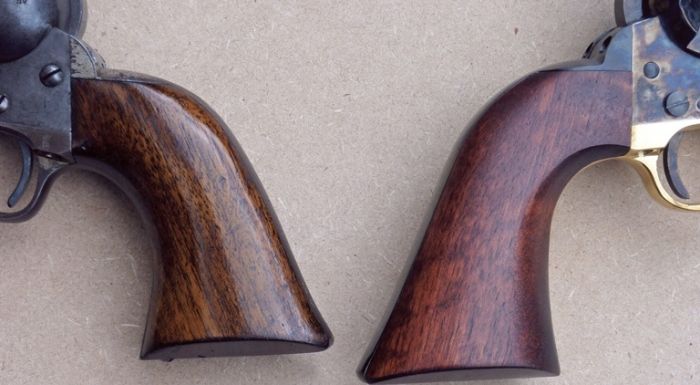
Pietta standardizes the 1860 Army and 1861 Navy grip frames to the same size — historically the Army grip was longer. Pietta's 1851 Navy grip more closely resembles the Army pattern than the original smaller Navy profile. Uberti cylinder front Ø for the 1860 Army ranges from 40.49–41.91 mm across production batches vs. originals at 41.15–41.23 mm. These deviations affect part interchangeability between makers and with original Colt parts.
Wedge & Arbor Compatibility
The barrel wedge used on Uberti 1851 Navy, 1860 Army, and 1861 Navy is cataloged as a single interchangeable part across all three models. The 1849 Pocket / 1862 Pocket Navy wedge is a smaller, separate part not interchangeable with the belt-pistol series. Dragoon wedges are distinct from all of the above. Mixing wedges across makers (Pietta, Uberti) may require light fitting due to individual frame slot variation.
Sources:
GUNS Magazine (J. Taffin) — Loading For Percussion Sixguns Part 2
Wikipedia — Colt Pocket Percussion Revolvers
Taylor's & Company — The Colt 1862 Pocket Navy Revolver
McDowell dimensional data via 1960nma.org (Colt 1860 Army measurements)
Buffalo Bill Center of the West — Powder Hour Blog: 1860 Army vs. 1861 Navy
CT Firearms Auction — Comparing Colt Revolvers
Social Media