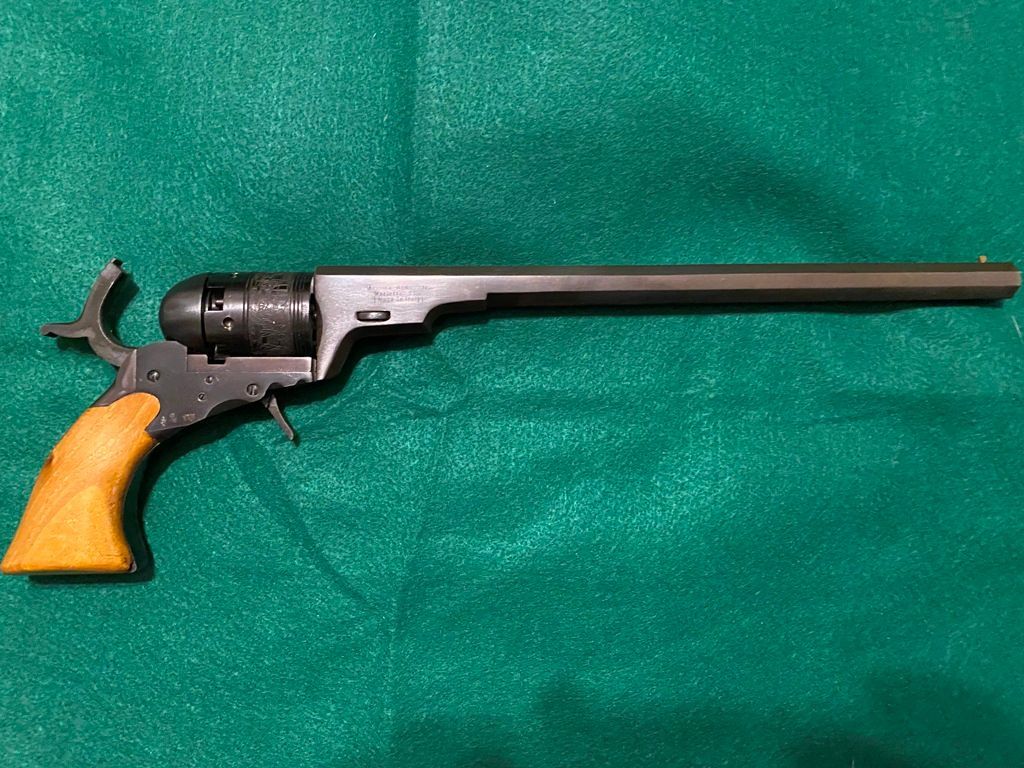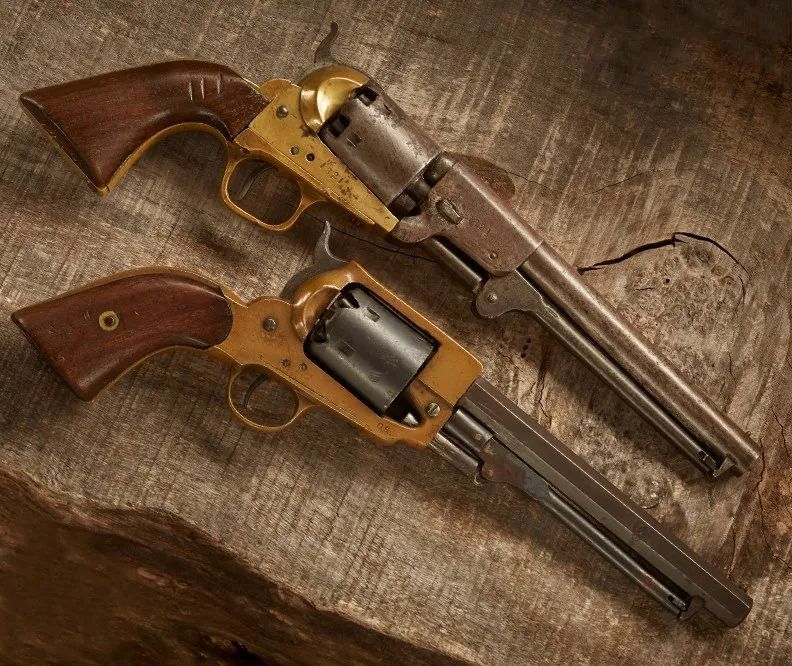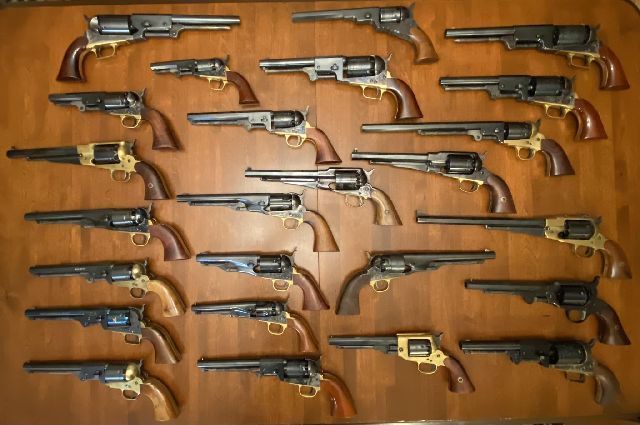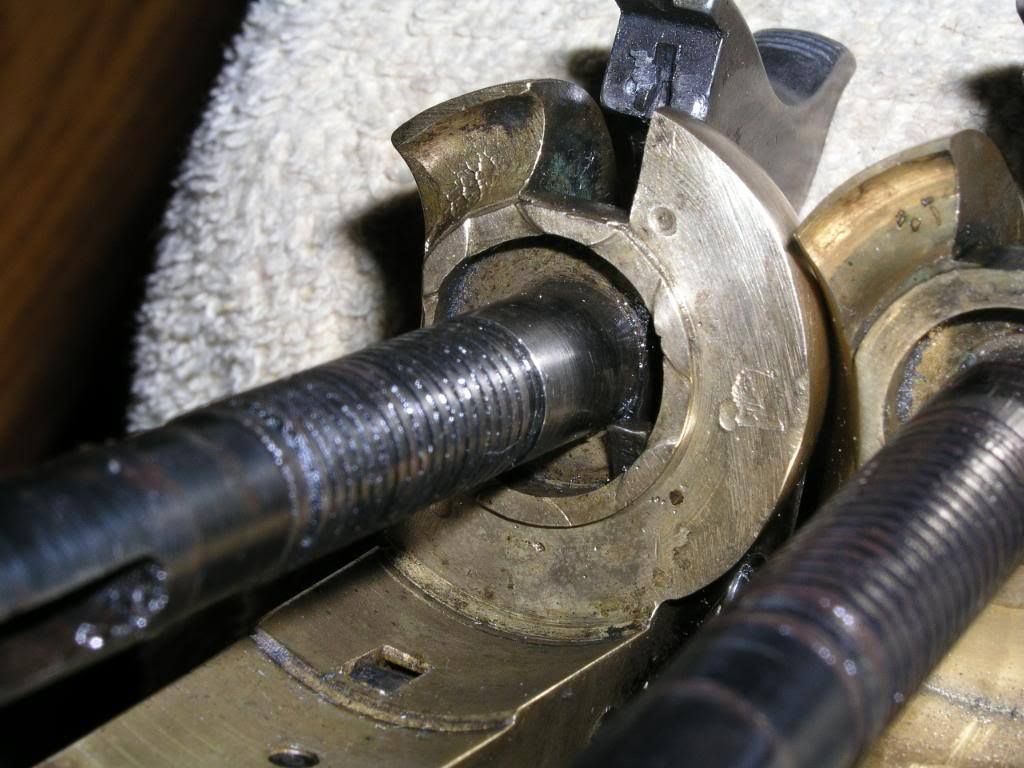
Centaure 1860 New Model Army Definitive Dating & Classification Guide
Based on the research program of the Friends of the Centaure Society (FROCS), documented at 1960nma.org
How to Use This Guide
Dating a Centaure is a triangulation process. No single indicator is definitive on its own — mixed-origin parts, factory reworks, and replacement cylinders all exist in the population. The method is:
- Read the proof mark combination → establishes the broadest date window
- Identify the inspector mark letter (if present) → narrows to a specific inspector's service period
- Read the barrel marking → corroborates or refines the date window
- Audit the physical indicators (arbor version, chamber size, backstrap type, screws, hammer spur, logo, rifling) → confirms pre- or post-1970 manufacture and flags mismatched parts
Cross-checking all indicators against each other is the only way to catch reworked guns, replacement cylinders, and the documented "Mixed Serial Reworks" (MSRs) that exist in the Centaure population.
Step 1 — The Proof Mark Combinations (Primary Date Anchor)
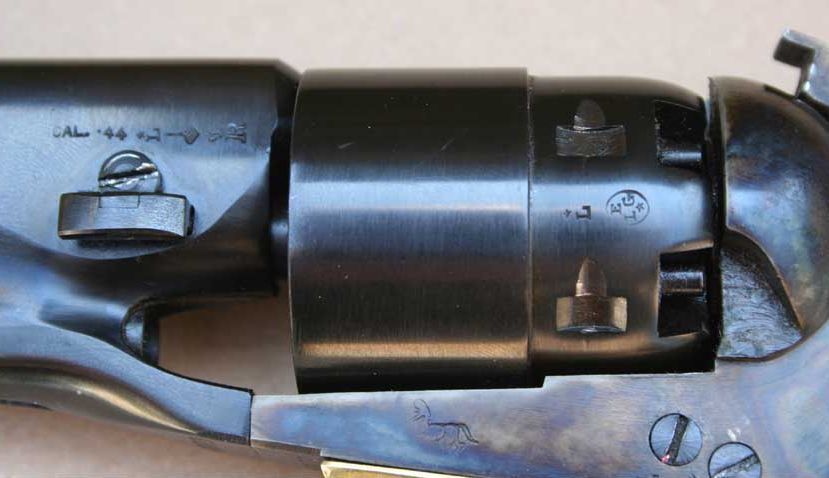
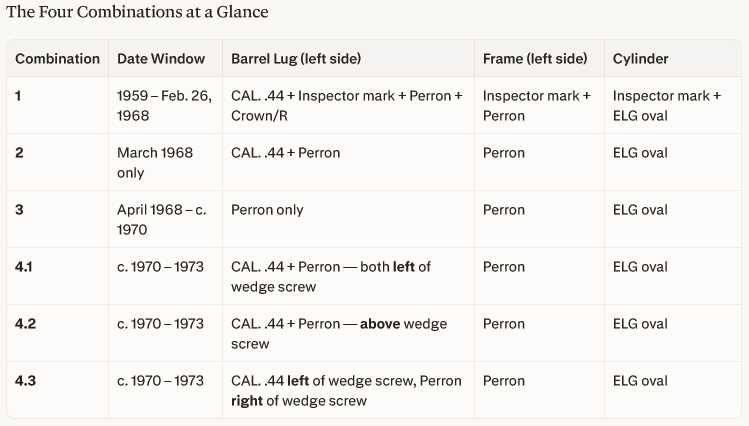
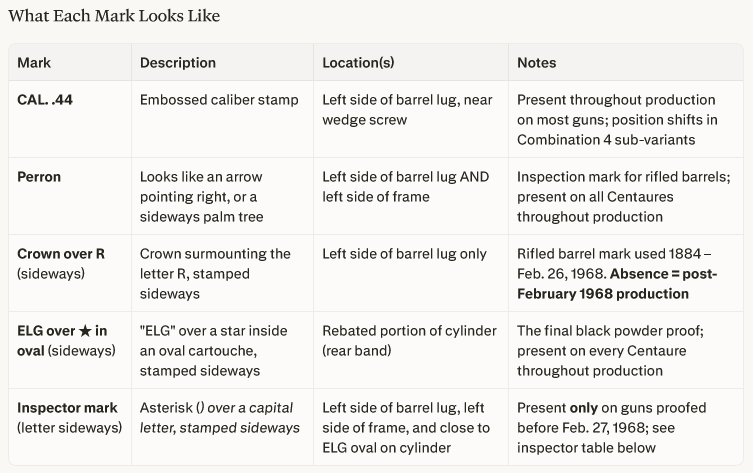
The Liège Proof House (Banc d'Épreuves des Armes à Feu) stamped every Centaure in three locations: the left side of the barrel lug, the left side of the frame, and the cylinder. FROCS has documented exactly four combinations of marks across the production run, each tied to a specific date window (FROCS — 2.4 Liège Proof House Marks).
The Crown over R Rule
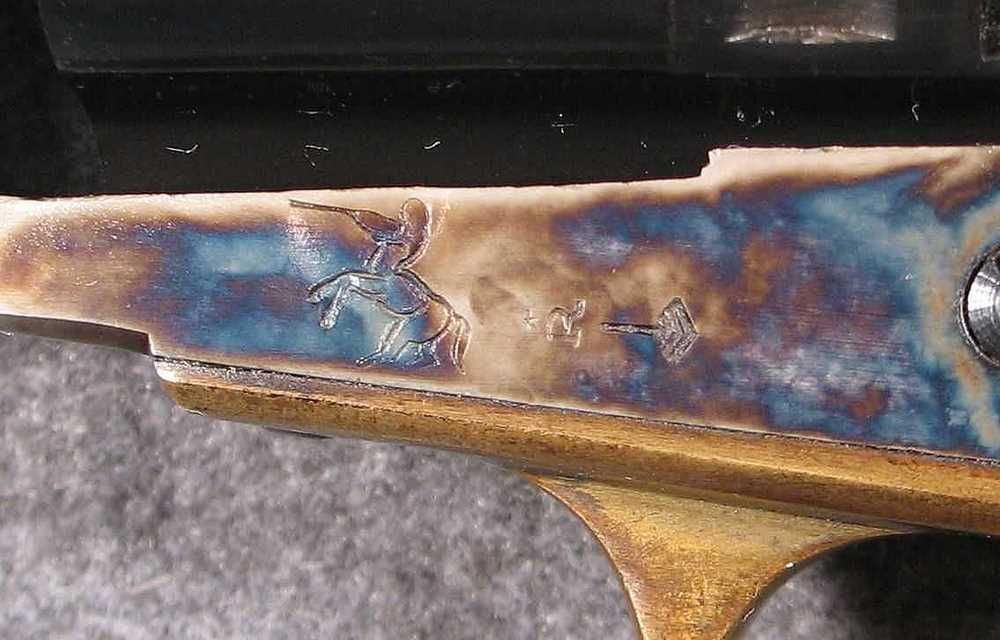
This is the single fastest date cut: find the Crown over R on the barrel lug left side, and the gun was proofed no later than February 26, 1968. Its absence places the gun in March 1968 or later. One look at the barrel lug can bracket the gun into a pre- or post-1968 category before anything else is examined (FROCS — 2.4).
Combination 2 — The Brief March 1968 Window
Combination 2 is transitional and extremely narrow — a single month, March 1968. These guns still carry the CAL. .44 on the barrel lug alongside the Perron, but lack both the Crown over R and any inspector mark. Encountering a Combination 2 gun is rare and definitively pinpoints proof testing to that one month (FROCS — 2.4).
Combination 3 — The Stripped-Down Mark
From April 1968 through approximately 1970, the barrel lug carries only the Perron — neither the CAL. .44 stamp nor an inspector mark. The frame also carries only the Perron. The cylinder retains the ELG oval. If your barrel lug shows nothing but the Perron (and no Crown over R, no CAL. .44, no inspector letter), you have a Combination 3 gun from this roughly 18-month window (FROCS — 2.4).
Combination 4 — The Return of CAL. .44 with Position Variants
From sometime in 1970 through early summer 1973, the CAL. .44 stamp reappears on the barrel lug but in three different positional arrangements relative to the wedge screw. The sub-variant (4.1, 4.2, or 4.3) cannot be precisely date-sequenced beyond "all are c. 1970–1973," but their presence confirms late production. All Combination 4 guns are post-1970 and will show cast backstraps and beefy screws — the forged-to-cast transition marker.
Step 2 — Inspector Marks: Narrowing Within Combination 1
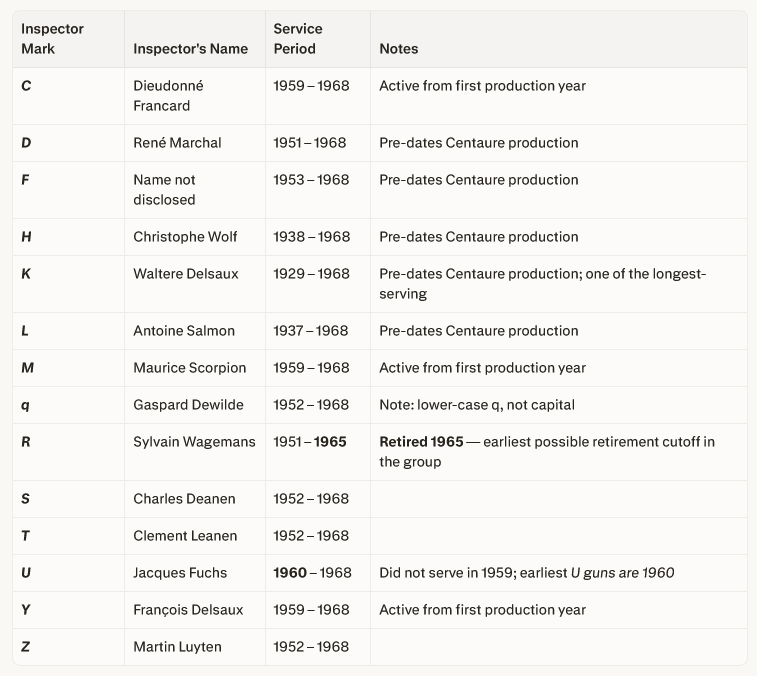
Every Centaure proofed between 1959 and February 26, 1968 (Combination 1) carries an inspector mark — an asterisk over a letter, stamped sideways — in three locations: barrel lug, frame, and cylinder. Standard procedure was one inspector per gun, so all three marks should be identical. A mismatch is a significant finding (see the cylinder-swap note in Step 5 below).
FROCS obtained the inspectors' identities after the Liège Proof House kept them secret for decades. Each inspector's service window allows further narrowing within the 1959–1968 Combination 1 period (FROCS — 2.4; FROCS — 1.4 Shore Collection):
Practical application
- A gun marked R must have been proofed no later than 1965, since Wagemans retired that year. This is the only inspector mark that provides a hard upper date cutoff earlier than 1968.
- A gun marked U must have been proofed no earlier than 1960, since Fuchs did not serve in 1959. Combined with a low serial number, this confirms 1960 production.
- Guns marked C or M or Y can date from 1959 onward — the first production year.
- All others (D, F, H, K, L, q, S, T, *Z) pre-date Centaure production and were active throughout the entire 1959–1968 window, so their marks provide no narrowing beyond the combination 1 date range.
Step 3 — Barrel Markings (Secondary Date Corroboration)
The top-of-barrel roll engraving provides an independent date bracket. FROCS has documented seven distinct regular-production marking variants (FROCS — 4.1 Conflicting Issues):
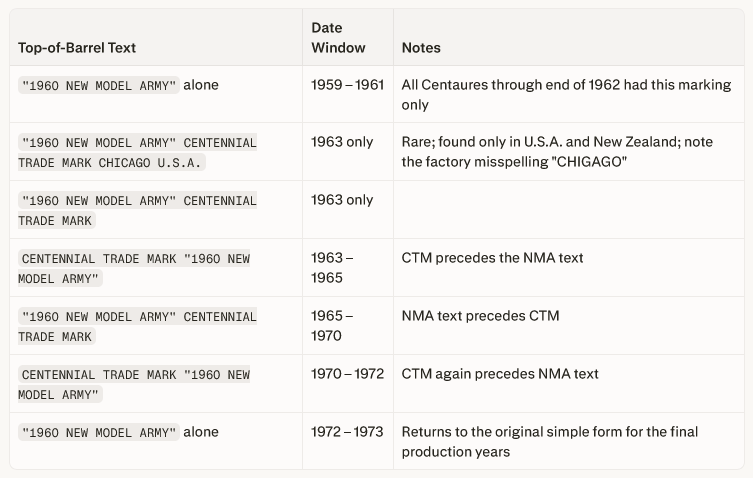
Source: FROCS — 4.1 Conflicting Issues
Key observations
- The CENTENNIAL TRADE MARK was added beginning in 1963 in a different font from the "1960 NEW MODEL ARMY" text. The font difference is visible to the naked eye on well-preserved examples. The TRADEMARK font is much smaller than the CENTENNIAL font.
- Marshal models and factory engraved variants do not follow this barrel marking scheme — exclude them from this table.
- A gun with the lone
"1960 NEW MODEL ARMY"marking can be either 1959–1961 (early) or 1972–1973 (late). The proof mark combination resolves this immediately: Combination 1 with inspector mark = early; Combination 4 = late. - The
CHICAGO U.S.A.variant (note the factory misspelling "CHIGAGO") is diagnostic for 1963 production only and is one of the rarer barrel markings in the population.
Step 4 — Serial Number as a Production Year Estimator
No factory records or proof house date logs survive for the Centaure production run. Serial numbers cannot be converted to precise production years using a lookup table. What FROCS has established through survey data are approximate serial number breakpoints that correspond to known manufacturing changes, allowing a range estimate (FROCS — 2.5 Milestones and Serial Numbers; FROCS — 2.1 Major Characteristics):
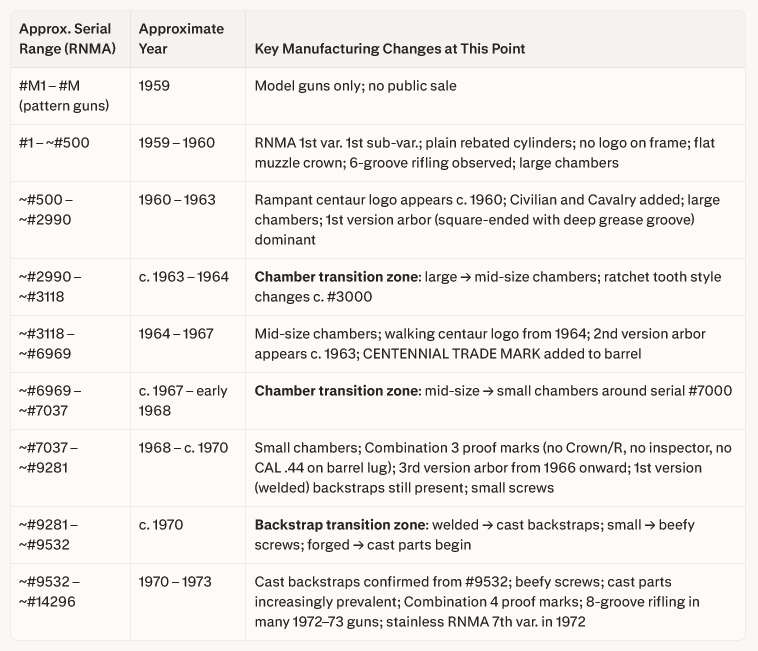
Important caveats:
- Serial number prefixes identify model: C-prefix = Civilian (separate block, #C1–#C932); F-prefix = Cavalry 1st variation (#F1–~#F1000) or Cavalry 2nd variation / Marshal 2nd variation (F above the digits on barrel lug only); no prefix = RNMA or Marshal 1st variation.
- Highest confirmed regular production serial: #14,296.
- Claims of 60,000+ units are a documented myth — FROCS estimates ~16,000 total (FROCS — 2.6 Total Production in Perspective).
Step 5 — Physical Indicators: The Pre-1970 vs. Post-1970 Classification
This is where the forged-to-cast quality divide becomes visible in hand. Work through these indicators systematically for each revolver.
5A — Backstrap Construction ✦ PRIMARY INDICATOR
This is the single most diagnostic physical feature for the forged/cast divide.
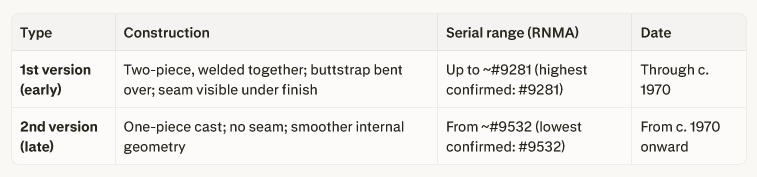
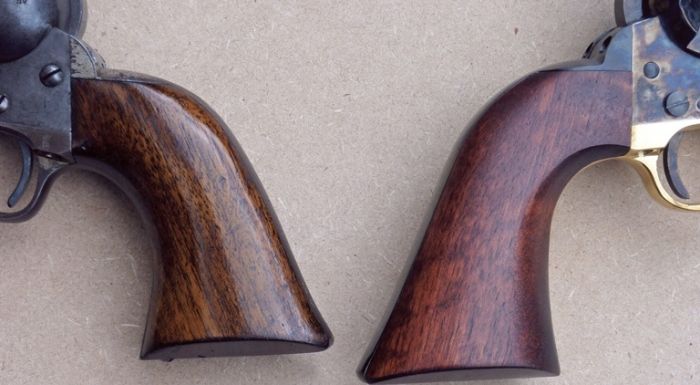
How to check: With the grip panels removed, examine the inner surface of the backstrap. The welded 1st-version backstrap shows a seam line where the two pieces were joined and the buttstrap section was bent over. The cast version has a seamless, homogeneous interior. Also note: backstraps without a toe on the butt (the notch for shoulder stock attachment) are always 1st-version welded types — these are believed to be leftover Civilian/Pocket Army parts fed into RNMA production.
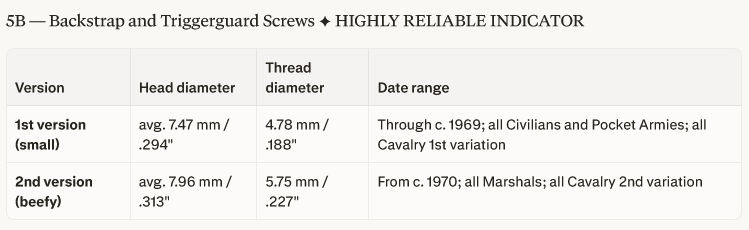
The transition within the RNMA line: highest confirmed small-screw RNMA is #8706 (1969); lowest confirmed beefy-screw RNMA is #9532 (sometime in 1970). A gap of roughly 825 serial numbers separates these confirmed bookmarks — guns in that window may show either.
How to check: Measure across the screw head face with a caliper. Small screws are distinctly narrower. The .019″ / 0.49 mm head diameter difference is clear under caliper measurement and visible by eye when comparing to a known example.
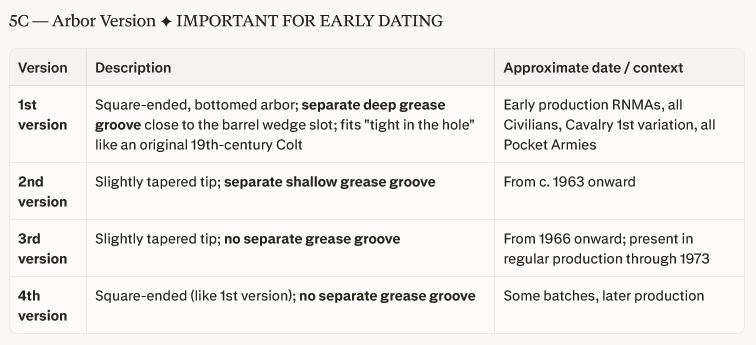
The evolution from 1st through 3rd version was F.A.U.L.'s cost-reduction program, completed around 1965–1966, achieved without compromising performance. The critical diagnostic is the grease groove: a deep separate groove = 1st version = early production. No groove at all = 3rd or 4th version = post-1966.
Important note on the 1st-version arbor: The early low-grade carbon steel arbors (susceptible to stretching under American powder loads) were replaced with harder steel in early 1961. The external profile of the 1st-version arbor remained the same; the metallurgical upgrade is not visible without destructive testing. However, a 1st-version arbor that has visibly stretched (arbor forward in the frame, cylinder not rotating cleanly, cylinder gap inconsistent) is diagnostic of a very early pre-1961 specimen that was never refitted.
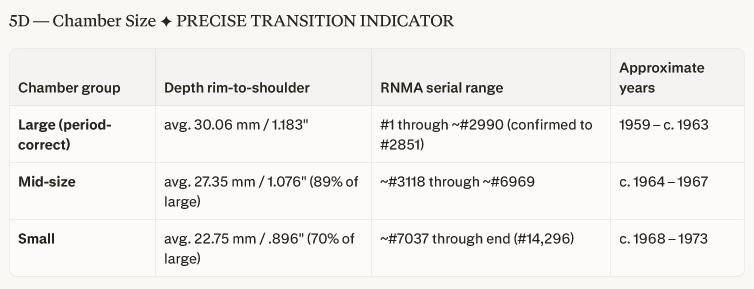
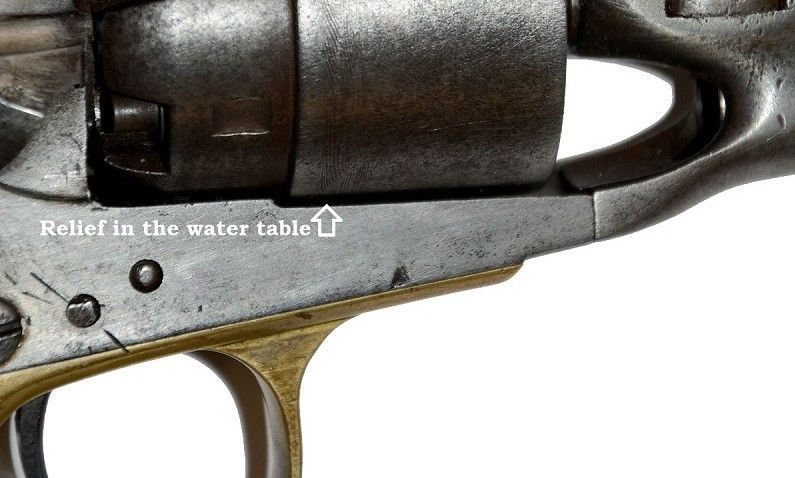
Chamber transition zones: large → mid-size around serial #2990–#3118 (c. 1964); mid-size → small around serial #6969–#7037 (c. end of 1967 to early 1968). All models and variations from the small-chamber era show this regardless of finish, steel type, or barrel length.
How to measure: With a depth micrometer or chamber depth gauge, measure from the cylinder face at the rim to the shoulder (step above the base of the nipple). Large = ~1.18″ depth; mid-size = ~1.08″; small = ~0.90″. The large chambers accommodate 40%+ more powder than the small; this has real implications for load data and performance, not just dating.
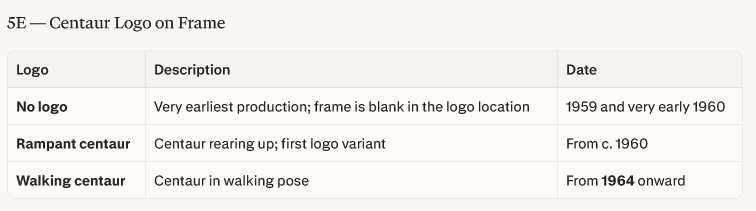
The logo change from rampant to walking occurred in 1964 per the FROCS milestones table (FROCS — 2.5). A rampant centaur on the frame places the gun firmly in 1960–1963. Absence of any logo is a strong indicator of 1959 or very early 1960 production (note: Civilian #C1, one of the earliest Civilian models, shows no logo). The walking centaur is consistent with 1964 through 1973 production.
From 1971 onward, some European-market RNMAs and Marshals received a silverish Centaure logo medallion inlaid in the grip panels — an optional enhancement particularly common on factory engraved specimens.
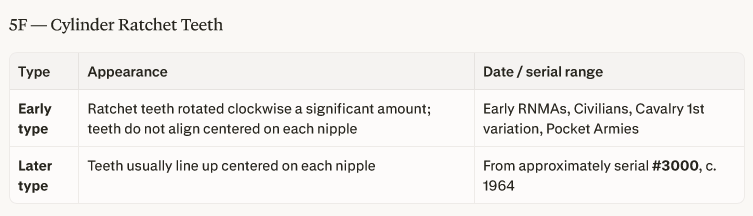
A relatively minor indicator compared to chambers or backstraps, but useful corroboration. The change coincides closely with the large-to-mid-size chamber transition, so both features should align in a consistent gun.
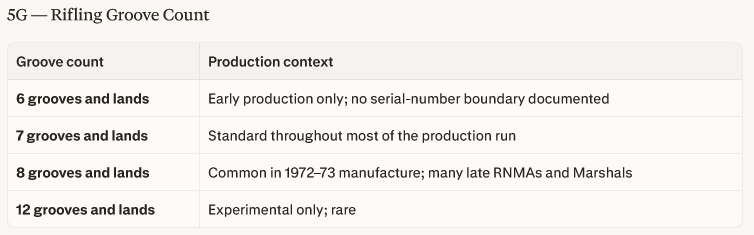
An 8-groove bore is a consistent late-production indicator. 6-groove is an early indicator, though the serial cutoff is not precisely documented by FROCS. Use a bore-scope or groove-counting plug to establish this.
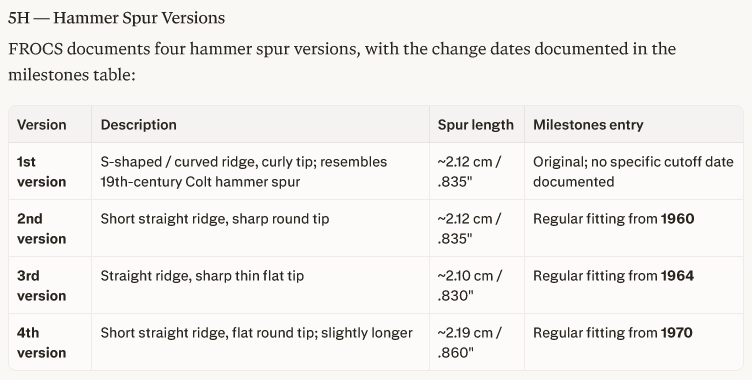
The milestones table (FROCS — 2.5) documents these transition years: 2nd version from 1960, 3rd version from 1964, 4th version from 1970. The 4th-version hammer spur is therefore associated with the cast-parts era and is a useful late-production indicator. The 1st-version spur is the most "historically correct" form, closest to original Colt Armies.
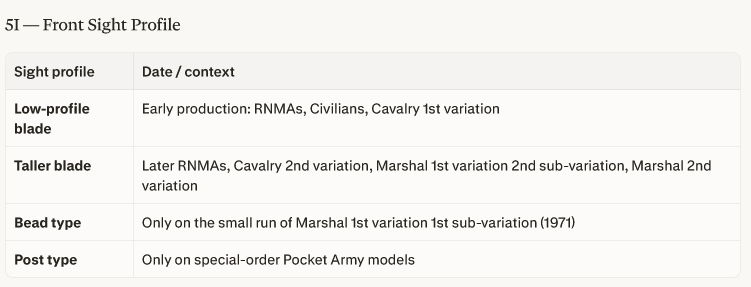
The raised front sight improved accuracy for competition shooters but reduced historical correctness. Its presence is a general indicator of later production, though not a precise date marker.
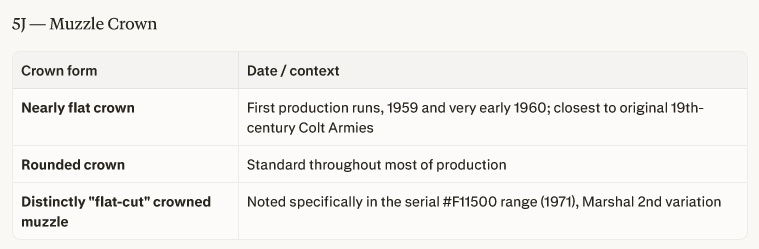
Muzzle diameter also increased during the production run, from 17.20 mm / .675″ at the start of production to 17.40 mm / .686″ by the end — a measurable change under calipers.
The Consolidated Classification Matrix
Work through each indicator for your revolver and map it to the era column. Consistent results in a single column indicate an unmolested, correctly assembled gun. Indicators spanning two columns signal either a rework, replacement parts, or a transitional production piece.
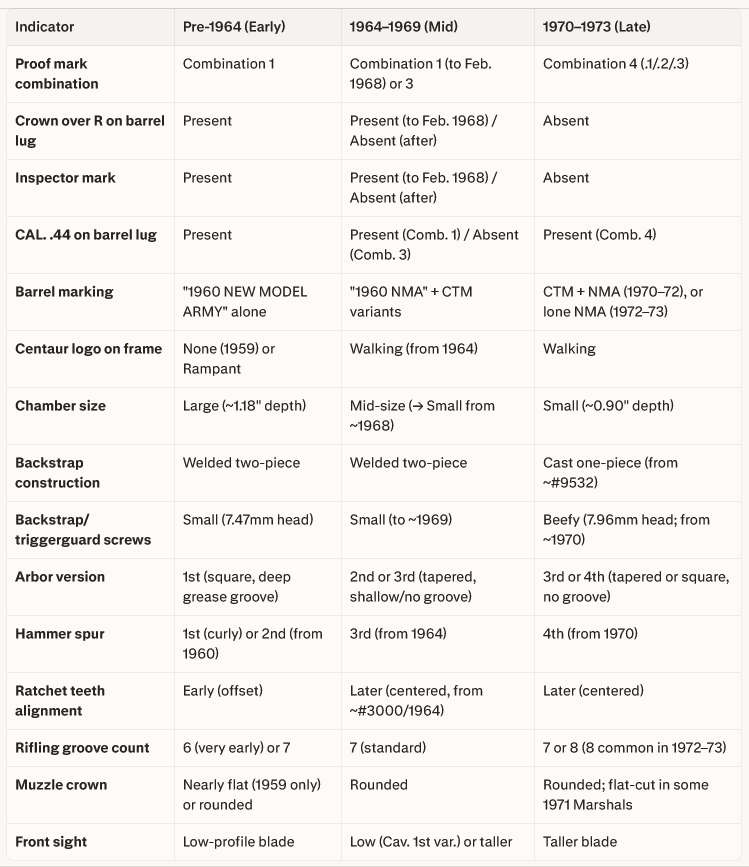
Step 6 — Flags for Mixed Parts and Reworked Guns
FROCS has documented a category of Mixed Serial Reworks (MSRs) — guns where newly made or renumbered visible-number components (barrel lug, frame, triggerguard) were mated with backstraps, cylinders, and hammers from other pistols, then finished as regular production. These are not fakes — they are factory reworks — but they can generate dating confusion.
Warning signs of a rework or parts mismatch:
- Mismatched inspector marks: The standard is one inspector per gun — all three marks (barrel lug, frame, cylinder) should be identical. Different marks on the cylinder versus the barrel lug and frame indicate either a replacement cylinder or a factory reassembly error after proof testing.
- Serial number on cylinder does not match visible serial number on barrel lug/frame/triggerguard: FROCS documents several specific cases where the cylinder is stamped with a different (usually lower) number than the visible locations. The lower number — typically found on the cylinder, hammer, and backstrap — is more likely to be the actual production serial.
- Barrel marking inconsistent with proof mark combination: For example, a lone "1960 NEW MODEL ARMY" barrel marking with Combination 4 proof marks signals either a very early barrel mated to late components, or a late gun with a remarkably persistent early barrel marking.
- Physical indicator era mismatch: Beefy screws with a welded backstrap, or a Combination 1 proof mark set with a cast backstrap, are both structurally impossible if the gun left the factory in one piece. Either indicates later service work or parts substitution.
- Cylinder inspector mark with an ELG oval of noticeably different style or strike depth: Replacement or extra cylinders (sold separately, proofed separately) carry the ELG oval but may show different inspector marks or proof mark positioning from the frame components.
Quick Reference — Decision Tree for Dating a Centaure
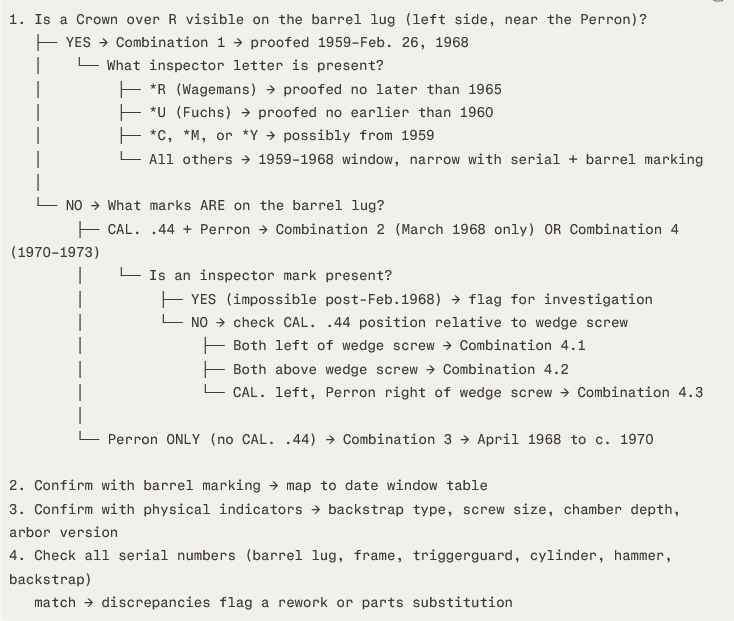
The guide contains everything needed to definitively date and classify any Centaure in your collection. In conclusion, here's a summary of the core methodology:
The Three-Layer Dating System
Layer 1 — Proof Mark Combination (hardest date anchor)
This is the fastest and most reliable starting point. The FROCS proof mark system gives you four combinations:1960nma
- Combination 1 (1959–Feb. 26, 1968): Crown over R + inspector letter + Perron + CAL. .44 on barrel lug; inspector mark + Perron on frame; inspector mark + ELG oval on cylinder
- Combination 2 (March 1968 only): CAL. .44 + Perron on barrel lug; no inspector mark anywhere — extremely narrow window
- Combination 3 (April 1968–c.1970): Perron only on barrel lug, no CAL. .44 — the most stripped-down mark set
- Combination 4.1/.2/.3 (c.1970–1973): CAL. .44 returns, but its position relative to the wedge screw is the differentiator between the three sub-variants
The Crown over R is the fastest single test: present = proofed by February 26, 1968; absent = post-February 1968.
Layer 2 — Inspector Letter (narrows within Combination 1)
The complete inspector table with names and service dates is in the guide. The critical shortcuts:
R (Wagemans) = hard cutoff of
1965;
U (Fuchs) = no earlier than
1960;
C,
M,
Y = possibly
1959.
Layer 3 — Physical Indicators (confirms era, flags mismatched parts)
The guide covers all ten physical indicators with precise measurements where available. The most decisive for the forged/cast divide:
- Backstrap type: welded two-piece seam (through ~#9281) vs. seamless cast (~#9532 onward)
- Screw head diameter: 7.47mm small (through ~#8706/1969) vs. 7.96mm beefy (~#9532/1970 onward)
- Chamber depth: ~1.18″ large (1959–c.1963), ~1.08″ mid-size (c.1964–1967), ~0.90″ small (c.1968–1973)
Hopefully this guide will be able to help you come up with a manufacture date for your Centaure.
Social Media