Centaure 1860 New Model Army: Manufacturing History, FROCS Findings, and the Machinery Myth
Manufacturing History, Findings and the Machinery Myth
Executive Summary
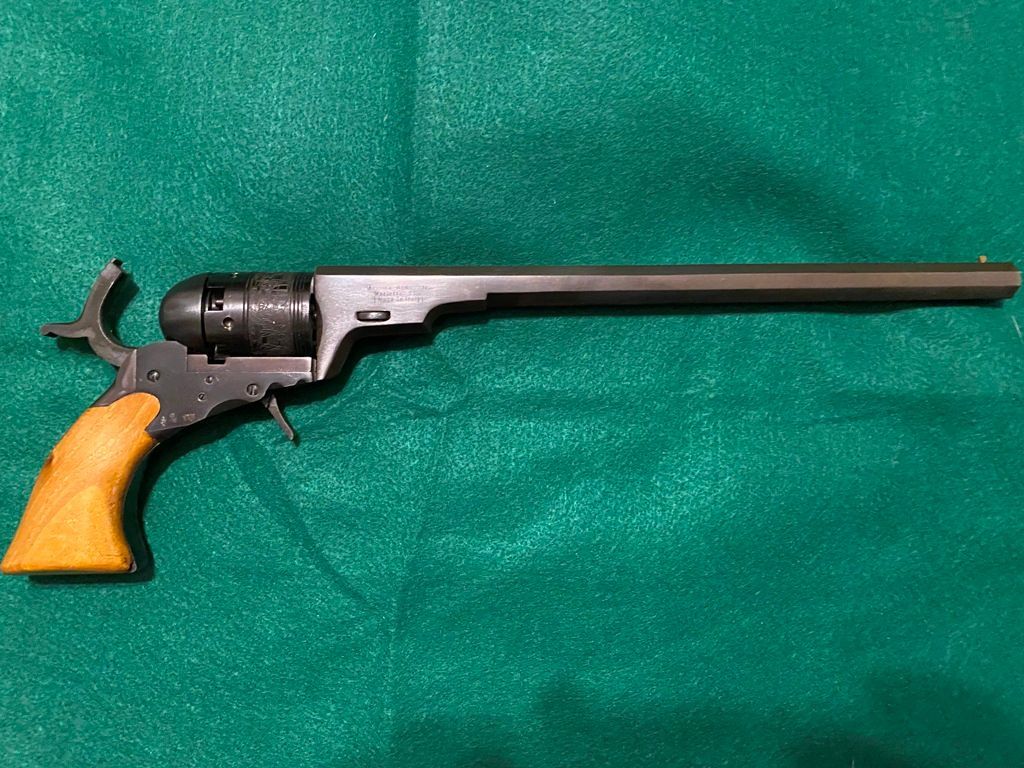
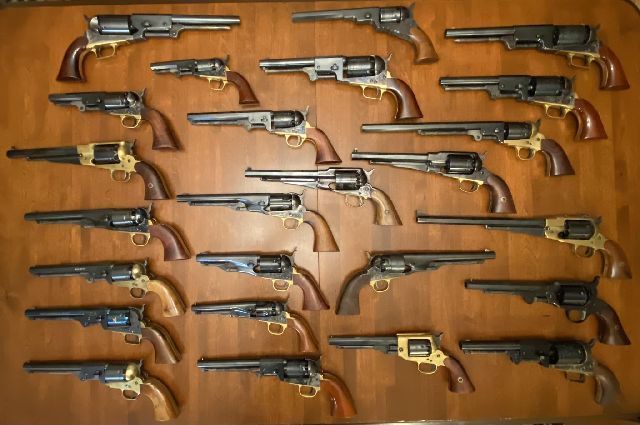
The Centaure 1860 New Model Army revolver — produced by Fabriques d'Armes Unies de Liège (F.A.U.L.) in Belgium between 1959 and 1973 — occupies a singular place in the history of percussion revolver replicas. It was the first mass-produced Colt 1860 Army-pattern percussion revolver made outside Hartford since Colt discontinued the original in 1873, predating Uberti's Italian version by four years and Colt's own "Second Generation" re-issue by nearly two decades. Yet the Centaure's historical reputation has been persistently entangled with a cluster of myths — most persistently, the claim that it was manufactured on transplanted 19th-century Colt machinery. The Friends of the Centaure Society (FROCS), whose ongoing research program began in 2007 and is documented at 1960nma.org, has methodically addressed these claims through serial number surveys, metallurgical analysis, and archival research. Their findings paint a picture that is both more prosaic and more technically impressive than the mythology suggests.
Background: F.A.U.L. and the Hanquet Dynasty
The institutional lineage of F.A.U.L. reaches back to 1796, when Martin Hanquet established the Hanquet gun business in Liège, positioning the family at the center of one of Europe's premier firearms manufacturing districts for generations. The company that eventually became Fabriques d'Armes Unies de Liège was registered with the Liège proof house from 1920 and operated from 22, Rue Trappé, Liège, where it would later manufacture the Centaures (littlegun.be).
The Centaure brand name itself — derived from the mythological centaur — was trademarked by F.A.U.L. as early as May 30, 1913, decades before the percussion revolver project launched (FROCS — 2.5 Milestones and Serial Numbers). By 1950, F.A.U.L. had become the official Colt distributor for Belgium, a commercial relationship it maintained until 1992, the year the company was sold. F.A.U.L. ceased all gun manufacturing in 1976, three years after Centaure revolver production ended.
At the time of Centaure production, the company was owned and managed by cousins Albert Hanquet (administration) and Paul Hanquet (operations). Paul Hanquet was the great-grandson of Jean-Baptiste Hanquet, who in April 1853 signed Samuel Colt's letter to the Liège gun trade laying out conditions under which Belgian makers could manufacture revolvers under his Belgian patent of 1849 (repliquesoldwest.superforum.fr). This 1853 licensing agreement — the subject of significant collector attention and confusion — was never formally terminated.
The 1853 Licensing Agreement: What It Actually Covered
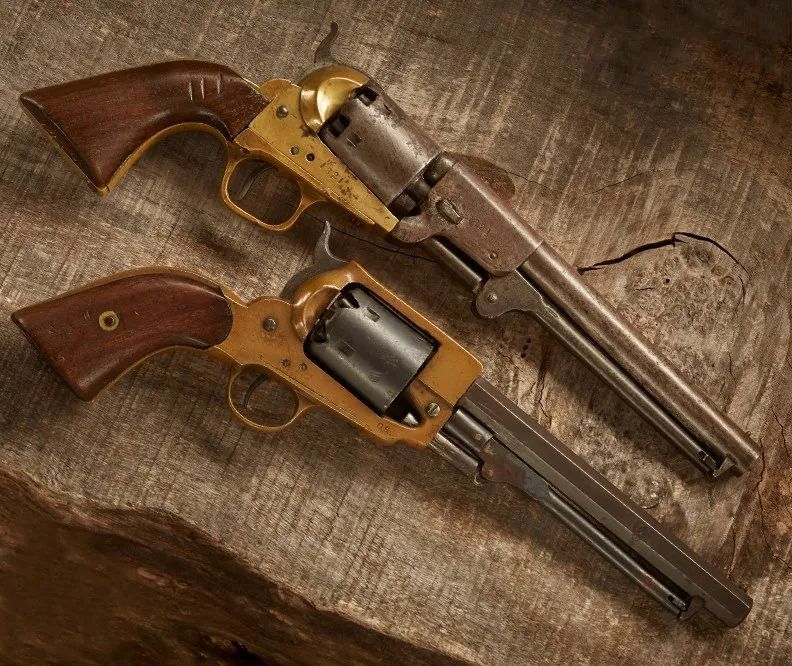
The April 1853 consortium consisted of seven Liège gun makers: Ancion & Co., Callotte, Dandoy, Drisseur & Co., Jean Hanquet, Petry, and Brothers Pirlot (FROCS — 2.5 Milestones and Serial Numbers). The license authorized production of open-top, hinge-loading-lever Colt patterns — the Walker, Dragoon, Navy, and Pocket types — which were manufactured throughout the 1850s and are today known as Colt Brevet revolvers. Critically, none of Colt's later advanced designs — the 1855 Roots, the 1860 Army, the 1861 Navy, or the 1862 Police — were ever manufactured as Brevets. These later Hartford designs used creeping-type loading levers and round barrels forged from silver steel, and they were never part of the Belgian license arrangement (FROCS — 2.5 Milestones). The Centaure, as an 1860 Army-pattern gun, therefore existed in a legally ambiguous zone: built by a successor to a licensed firm, using a never-cancelled agreement that had never actually covered the 1860 Army pattern.
Genesis of the Centaure Project: Edwards, Shore, and a Deliberate Design Choice
The Centaure project was not a Belgian initiative. It was conceived and financed by two Americans: William B. Edwards, a renowned Civil War and firearms historian who served as an international consultant to the gun industry, and Sigmund Shore, a businessman who provided financing (GunsAmerica). Edwards, described by FROCS as "the visionary who made Centaures (and Uberti percussion revolvers for that matter) reality," had previously been associated with Centennial Arms Corp., the Chicago-area importer that would handle U.S. distribution of the finished revolvers (FROCS — 7.2 Helpful Background Information).
Edwards and Shore specifically selected F.A.U.L. for the project. To supply the factory with reference standards, Edwards provided two original Colt 1860 Army revolvers from his personal collection as pattern guns — one of them serial numbered #138572, a production of 1863, rediscovered by FROCS researcher "Arizona Pete" in March 2019 in the Hanquet family's gun collection (FROCS — 2.9 Production of the Centaures). These firearms were not used as dimensional blueprints in any formal engineering sense; rather, they provided F.A.U.L. technicians with reference data on finishing, polishing technique, and bluing color.
The role of Centennial Arms Corp. in the U.S. market was handled through its sister company Mars Equipment Corp. of Chicago, which managed ordering, importing, and the military surplus operations of the Shore Group. Many American buyers came to perceive Centennial Arms as the manufacturer of the guns rather than the importer, an impression Centennial never went out of its way to correct — they rarely highlighted F.A.U.L.'s involvement in their advertising (FROCS — 4.1 Conflicting Issues).
Production Era, Models, and Serial Numbers
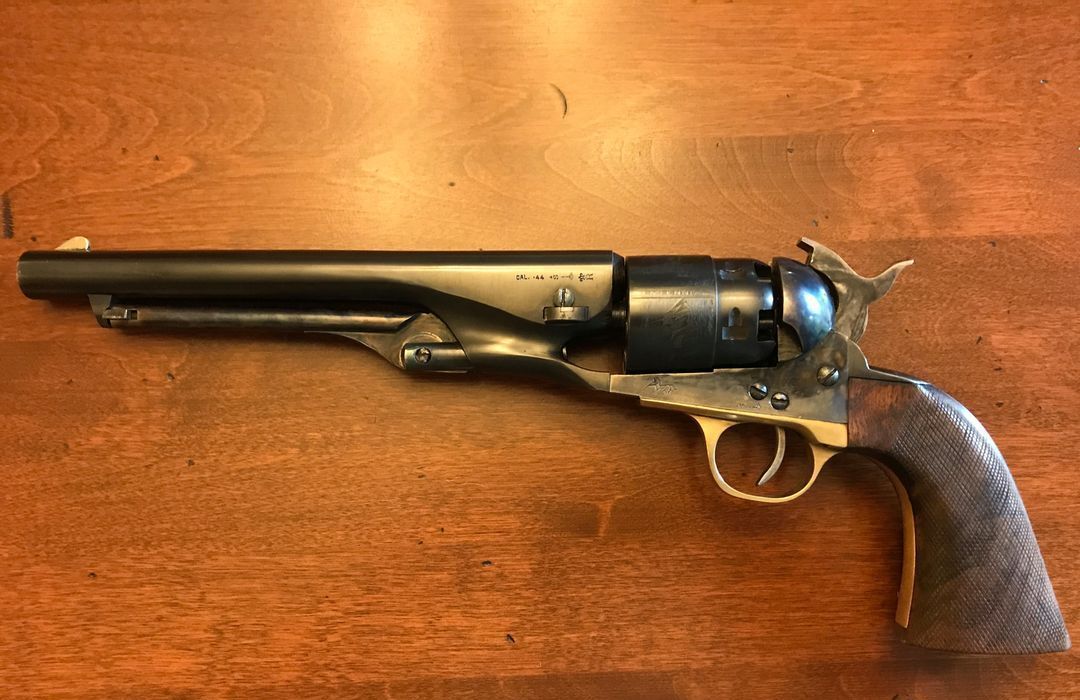
Centaure production ran from fall 1959 through early summer 1973 — a 14-year production window. F.A.U.L. manufactured five basic models:
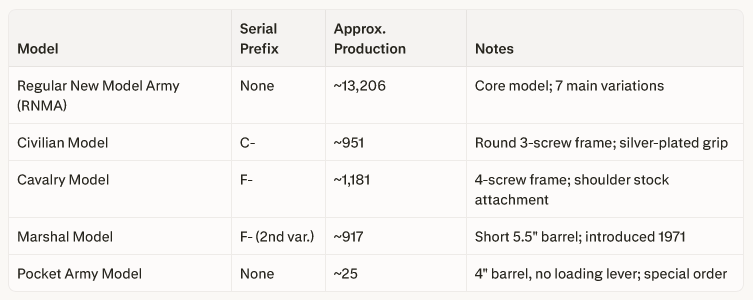
FROCS estimates total production at approximately 16,000 units, based on extrapolation from 1,620 guns entered into the FROCS survey database by August 2022 (FROCS — 2.6). This directly refutes a long-circulated claim — originating with a 1971 article by H. J. Stammel — that production reached 60,000 units. FROCS: "Myth busted." The highest regular-production serial number confirmed in the survey is #14,296.
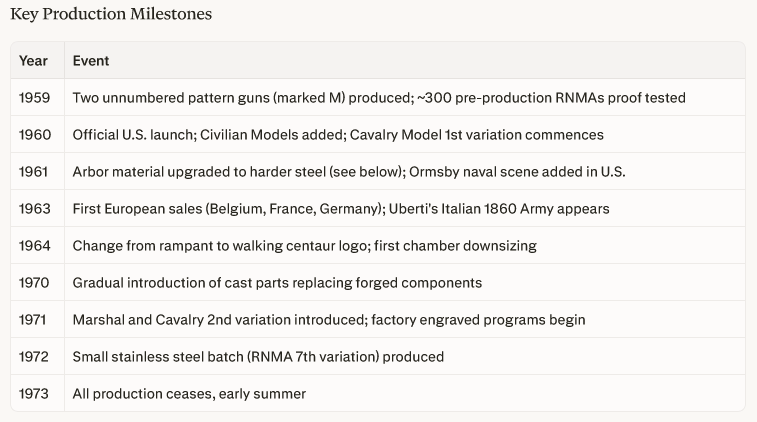
Actual Manufacturing Process: What the Evidence Shows
Outsourced Machining — The Roncarati Connection
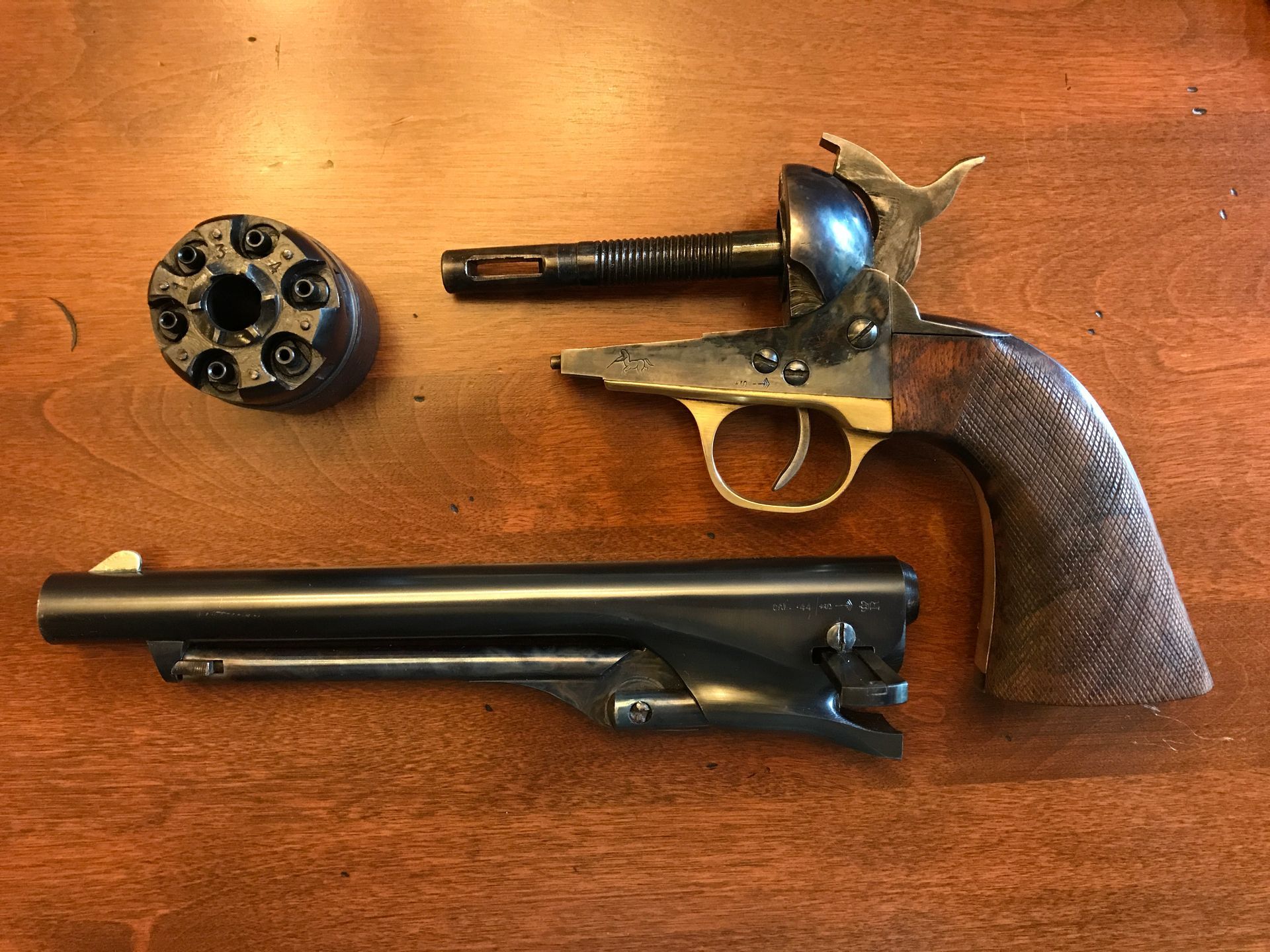
F.A.U.L. operated in the traditional Liège manner: major machining was outsourced to regional subcontractors, with final assembly and finishing occurring at the Rue Trappé facility. The primary machining subcontractor was the Liège machine shop of A. L. Roncarati, an Italian immigrant (FROCS — 2.9 Production of the Centaures). At the Roncarati shop:
- Barrels were machined to shape from tool steel
- Frames were machined from solid forgings
- Cylinders were lathed from stock
- Loading levers were color case hardened
Early backstraps were fabricated in two pieces, welded together and bent — an approach chosen specifically to avoid the need for specialized tooling. Cast backstraps replaced this method in later production.
Intensive Hand Work
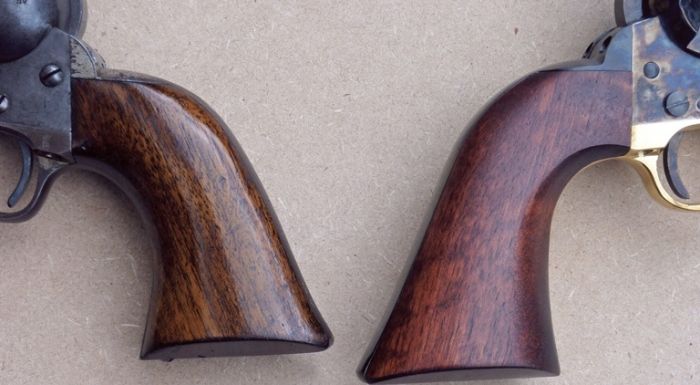
Contrary to any notion of automated factory production, the Centaure manufacturing process was labor intensive and manual at virtually every finishing stage. According to Edwards's associate Leslie Field, a single craftsman was responsible for achieving the correct S-curve of the barrel lug. Another workman removed all square edges using a metal cutting knife, again entirely by hand. One-piece wooden grips were produced in Ougrée, Belgium, hand fitted to trigger guards and backstraps, then assembled as a unit — accounting for the characteristically tight metal-to-wood fit of surviving Centaures (FROCS — 2.9).
Guns were assembled in the white, serial-numbered, then disassembled for bluing and case hardening before final reassembly.
Proof Testing at Liège
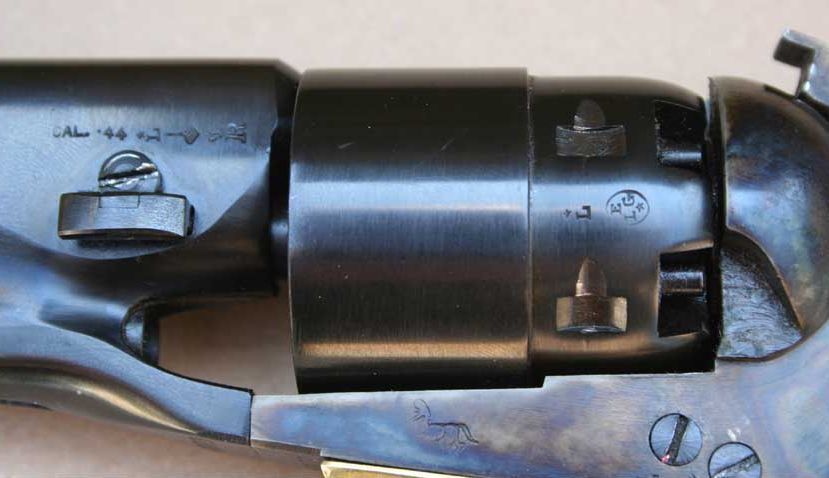
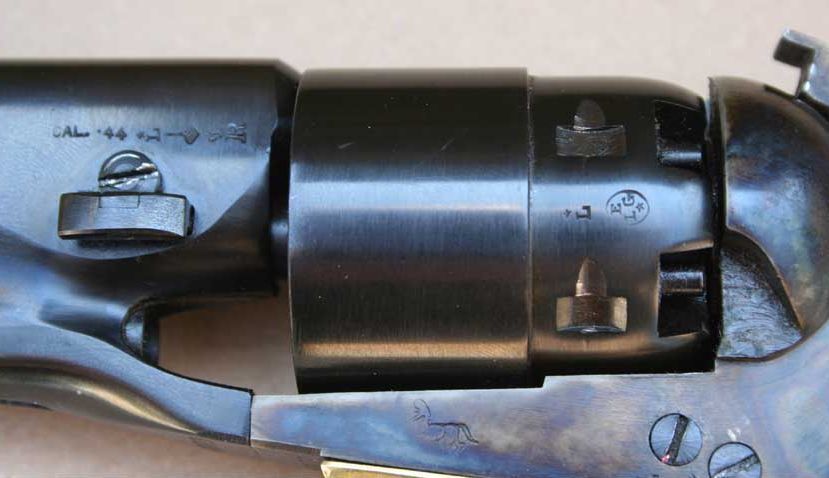
Every completed Centaure was proof tested at the Banc d'Épreuves de Liège (the Liège Proof House) with a heavy charge of lead over a heavy, wadded charge of black powder. Guns that passed received the ELG oval on the cylinder and the Perron de Liège — a stylized arrow mark — on the left side of the barrel lug and frame. Only after return from the proof house were barrel markings and the centaur logo applied at F.A.U.L. (FROCS — 2.9).
The "Original Colt Machinery" Myth: Origins and Demolition
The Claim
The most persistent piece of Centaure lore holds that F.A.U.L. manufactured these revolvers using 19th-century machinery that had originated with or been used by Colt. In some tellings, the old Colt tooling was physically transported to Belgium; in others, the factory retained original Victorian-era equipment from the Brevete licensing era. Forum posts from the mid-2000s repeated variations of this narrative as established fact, and some dealers invoked it to support valuations and provenance claims.
Where the Myth Comes From
Three interlocking historical facts created fertile ground for this story:
- The 1853 licensing connection: The Hanquet family's genuine participation in the Colt Brevete consortium — a real contractual relationship with Samuel Colt — lent plausibility to the idea that some form of original Colt manufacturing inheritance persisted into the 1960s. The agreement was never cancelled, which enthusiasts sometimes read as evidence of institutional continuity.
- F.A.U.L.'s distributor relationship with Colt: From 1950 onward, F.A.U.L. was the official Colt distributor for Belgium. FROCS notes that the factory was "occupied at the time for other gun production and to manufacture selected spare parts for Colt's in Hartford" — language that, when misread or partially quoted, could be taken to imply official Colt machinery was on site.
- Marketing ambiguity: Centennial Arms' advertising consistently emphasized Colt heritage and the Belgian gun-making tradition without ever precisely describing the actual manufacturing process. The mystique of Liège craftsmanship and the Colt name did the rest.
FROCS Verdict: Myth Busted
FROCS devotes a specific "Myth Buster" section to these claims in Chapter 2.9, rendering the following explicit judgments:
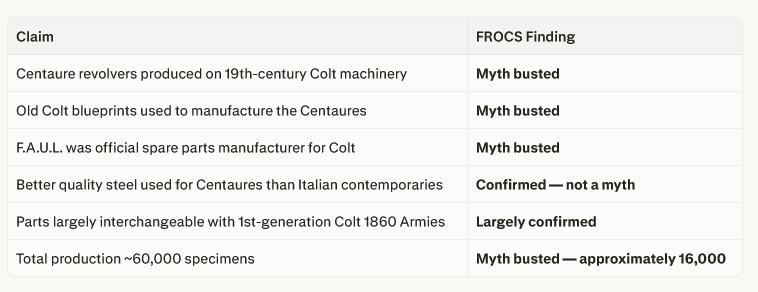
The evidence is unambiguous. Edwards supplied two original Civil War-era Colts as physical patterns, not blueprints. F.A.U.L. was never assigned the status of an official spare-parts manufacturer for Colt. Whatever machinery was in use at Rue Trappé was F.A.U.L.'s own, and by multiple contemporary accounts it was not new: sources describe it as "pretty old and worn out," with much of the precision work achieved through skilled hand labor rather than machine consistency (FROCS — 2.9). The GunsAmerica author Paul Helinski, writing with characteristic bluntness, puts the probability of Colt machinery involvement at essentially zero, noting that any historically significant Colt tooling "would have been auctioned to collectors long before 1960."
An Early Quality Failure Underlines the Point
If original Colt machinery had been in use, dimensional consistency with Hartford production would have been automatic. The early production record shows the opposite. Quality Control rejected the first production revolvers because barrels did not align correctly with cylinders and frames. The initial arbors were made of low-grade carbon steel — the result of a translation error in Edwards's manufacturing instructions — and these arbors stretched when fired with standard American black powder loads. Early dimensional calibrations had been based on Belgian proof loads, which were substantially lighter than the charges U.S. buyers habitually used. The arbor was upgraded to harder steel in early 1961, well into the production run, and the trigger guard tooling had to be corrected after a dented sample gun (dropped on concrete by Edwards) caused F.A.U.L. to unknowingly replicate the deformity in thousands of guards before the error was caught prior to the first U.S. shipment (FROCS — 2.9). None of this resembles a factory operating from validated Colt tooling.
Steel: Modern Metallurgy in a 19th-Century Form Factor
This is the domain where the Centaure's reputation is most firmly grounded in documented fact rather than myth.
Primary Material: High-Grade Forged Tool Steel
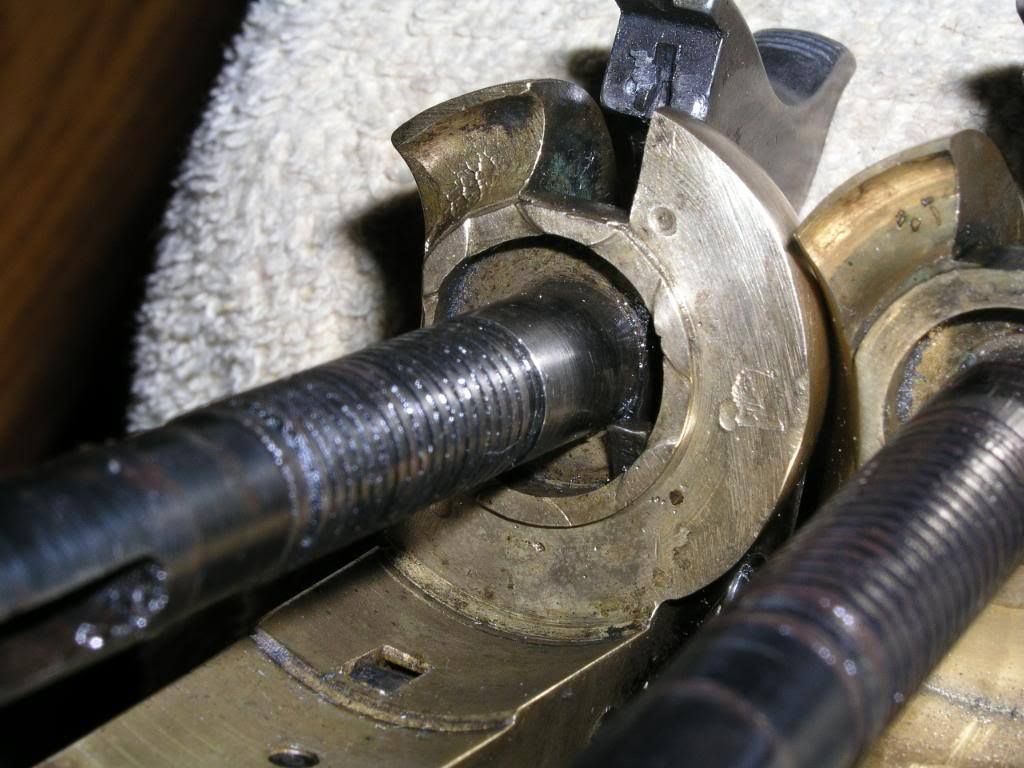
F.A.U.L. used high-quality forged carbon steel of particular hardness for barrels, cylinders, frames, backstraps, and loading presses. FROCS confirms that this steel is measurably harder than the alloy used in Italian percussion revolver clones of the same era (FROCS — 2.1 Major Characteristics). This was a deliberate modern specification, not a continuation of 19th-century Colt standards. Original Colt 1860 Armies were forged from what Hartford termed "silver steel" — a specific mid-19th-century tool steel composition — and their cylinders exhibited six structural weak spots in the rear chamber wall area visible in cross-section analysis. Centaure cylinders, machined from superior modern stock, do not share these vulnerabilities.
The Arbor Upgrade (1961)
The most consequential early metallurgical revision was the switch from low-grade carbon steel arbors to harder steel arbors in early 1961. The original specification had been calibrated for Belgian proof loads; the revised arbor material and hardness were chosen to withstand American shooting practice. This upgrade is well-documented in FROCS research and is an identifiable dateline for early vs. later production specimens (FROCS — 2.9).
Rifling: Modern Process, Non-Period Specification
The Centaure's bore departs substantially from 19th-century Colt practice. Rather than the deep, wide-groove rifling of original Hartford guns, F.A.U.L. used modern shallow rifling with constant twist, cut by the button rifling process — a 20th-century production method. The standard configuration featured 7 grooves and lands, though early examples with 6 grooves are documented and late production (1972–73) examples with 8 grooves and lands appear regularly. F.A.U.L. even experimented with 12-groove rifling. Barrel groove diameter was standardized at .446 inch, with chamber diameter matched to groove diameter — a departure from original Colt practice that reduced gas leakage and improved energy transfer (FROCS — 2.1).
The Cast-Parts Transition (c. 1970)
From approximately 1970 onward, previously forged components began to be replaced with cast parts, including a change to cast backstraps. This is a critical diagnostic marker for collectors and is associated with the quality degradation noted in late production guns. The forged-to-cast transition was an economic response to intensifying competition from Italian and Spanish replica manufacturers flooding the market with lower-cost production (FROCS — 2.6).
Stainless Steel Variant (1972)
A small batch of RNMA 7th variation revolvers were manufactured from magnetic stainless steel alloy in 1972, marketed in Germany. These represent the first stainless percussion revolvers produced. The batch was small (production aborted the same year) and these guns are among the rarest Centaure variants. The stainless finish was also approximated in the "in the white" high-gloss polish offered on earlier guns from 1971 — a finish that received special heat treatment as rust protection rather than traditional bluing (FROCS — 2.1).
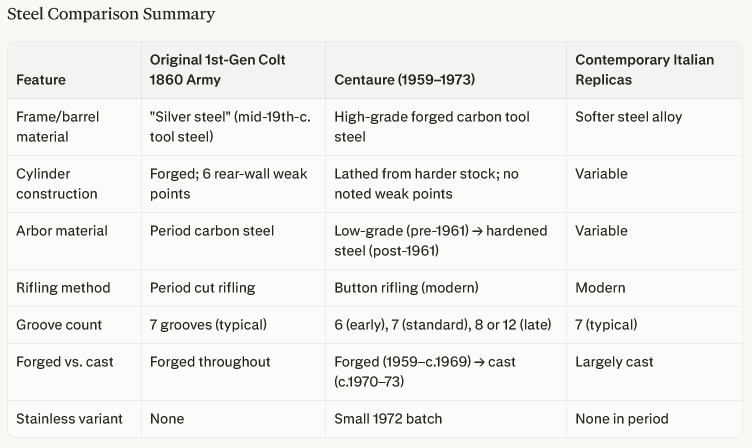
Sources: FROCS — 2.1; FROCS — 2.9; capandballrevolvers.com
The "Second Generation Colt" Debate
A related and persistent claim — distinct from the machinery myth — holds that the Centaures are effectively "real Second Generation Colt Armies" by virtue of the never-cancelled 1853 license. Some enthusiasts argue the Centaures possess more authentic "DNA" from the original Colt production tradition than the guns Colt itself made under the Blue Dome in Hartford beginning in 1977.
FROCS engages this debate seriously but does not settle it with a simple verdict, framing it as "Are the Centaures Armies re-issues or replicas?" (FROCS — 4.1 Conflicting Issues). The factual record makes the position difficult to sustain in its strongest form:
- The 1853 license never covered the 1860 Army pattern — only open-top, hinge-lever models
- The Centaures were reverse-engineered from two collector's guns, not from Colt documentation
- F.A.U.L. received no engineering transfer, no blueprints, and no tooling from Hartford
- Colt's actual 2nd Generation Armies (1977–1982) were made in Hartford; their 3rd Generation (1994–2002) likewise
The confusion is compounded by the branding decisions of Centennial Arms, which chose names ("Centennial Army," "1960 New Model Army") and a logo that referenced Colt heritage without precision, and by the European market, where the guns were simply called Centaures after the corporate logo — a rampant, later walking, centaur figure on the left side of the frame (FROCS — 4.1).
The GunsAmerica article describes the guns as "historically challenged" — not worthless, but loaded with a heritage narrative that exceeds what the documentary record can support. That characterization captures the essential tension: the Centaure is a genuinely superior revolver made with demonstrably better steel and tighter hand labor than its Italian contemporaries, but it is not the direct institutional descendant of Hartford production that the mythology describes.
Quality Arc: From Premier Product to Production Casualty
FROCS research traces a clear quality arc across the 14-year production run:
1959–1969 (Peak period): Forged tool steel throughout, meticulous hand fitting, tight tolerances. The most desirable collector examples date from this window. Barrels, frames, and cylinders were all forged, with hand work accounting for the characteristic close fit of metal to wood. A few early quality control rejections (misaligned barrels) and the initial arbor failure were corrected by 1961.
1970–1973 (Decline period): Increasing competition from mass-produced Italian and Spanish replicas forced cost reductions. Cast parts replaced forgings progressively from 1970. Quality became "spotty" — FROCS documents contemporary accounts of guns failing within the first few cylinders. The combination of high production cost and uneven quality ultimately forced F.A.U.L. out of percussion revolver production in 1973 and out of gun manufacturing entirely by 1976 (FROCS — 2.9; FROCS — 4.1).
FROCS's summary judgment: excluding the late-production fall-off, Centaure workmanship was better than contemporary Italian reproductions. But this conclusion is qualified — it applies primarily to the pre-1970 production window.
FROCS: The Research Organization
The Friends of the Centaure Society (FROCS) was established in September 2007 as an international, non-profit special interest group for Centaure collectors, reenactors, and shooters, growing from a transatlantic research collaboration between Germany and Texas (FROCS — 2.6). Membership requires ownership of at least one Centaure and completion of a detailed survey questionnaire (available in English, French, and German) that contributes specimen data — serial numbers, proof marks, metallurgical characteristics, variation identification — to the collective database.
The organization maintains an active publication program at 1960nma.org, hosts regular meetings featuring lectures, shooting matches, on-site repairs by attending gunsmiths, and coordination on spare parts sourcing. The late Dr. James L. Davis, founder of the Replica Percussion Revolver Collector's Association (RPRCA), served as a key mentor to the FROCS research program from 2007 until his death in September 2019. Contributing researchers include Dennis Russell (author of Percussion Colt Revolvers — The Second Generation) and Roy Marcot (co-author of Colt Brevete Revolvers), who provided key information on the 1853 licensing agreement (FROCS — 7.2).
The FROCS survey database, built from approximately 1,620 reported specimens as of August 2022, forms the empirical backbone of all production estimates and variation chronology in this report.
Conclusion: Lore vs. Evidence
The Centaure's mythology — original Colt machinery, second-generation status, 60,000 guns produced — arose from a confluence of genuine historical connections (the 1853 license, F.A.U.L.'s Colt distributorship, the Hanquet family lineage), deliberate marketing ambiguity by Centennial Arms, and the natural tendency of collector communities to romanticize provenance. The FROCS research program has done the rigorous work of separating documented fact from inference and tradition.
What the evidence confirms:
- F.A.U.L. made approximately 16,000 Centaures between 1959 and 1973, using its own subcontractors and hand labor — not Hartford tooling
- The guns were reverse-engineered from two original Civil War Colts supplied by William B. Edwards, not from Colt blueprints or engineering documentation
- F.A.U.L. used high-grade modern forged tool steel — demonstrably superior to contemporaneous Italian competitors — with 20th-century button rifling
- The transition to cast parts around 1970 marks the quality inflection point
- The 1853 license was real and never cancelled, but it covered only open-top pattern revolvers and conferred no manufacturing inheritance for the 1860 Army design
- The Centaure was the first mass-produced 1860 Army-pattern revolver made outside Hartford, predating both Uberti and Colt's own re-issues by years
What the evidence does not support:
- Any transfer of Colt machinery to Belgium
- Any use of Colt blueprints or formal engineering documentation
- F.A.U.L.'s status as an official Colt spare-parts manufacturer
- A total production anywhere near 60,000 units
- The Centaure's classification as a "Second Generation Colt" in any institutional sense
Social Media