Reading Replica Revolver Markings: Proofmarks, Maker’s Marks, Importer Marks, and Dealer Marks
Reading Replica Revolver Markings
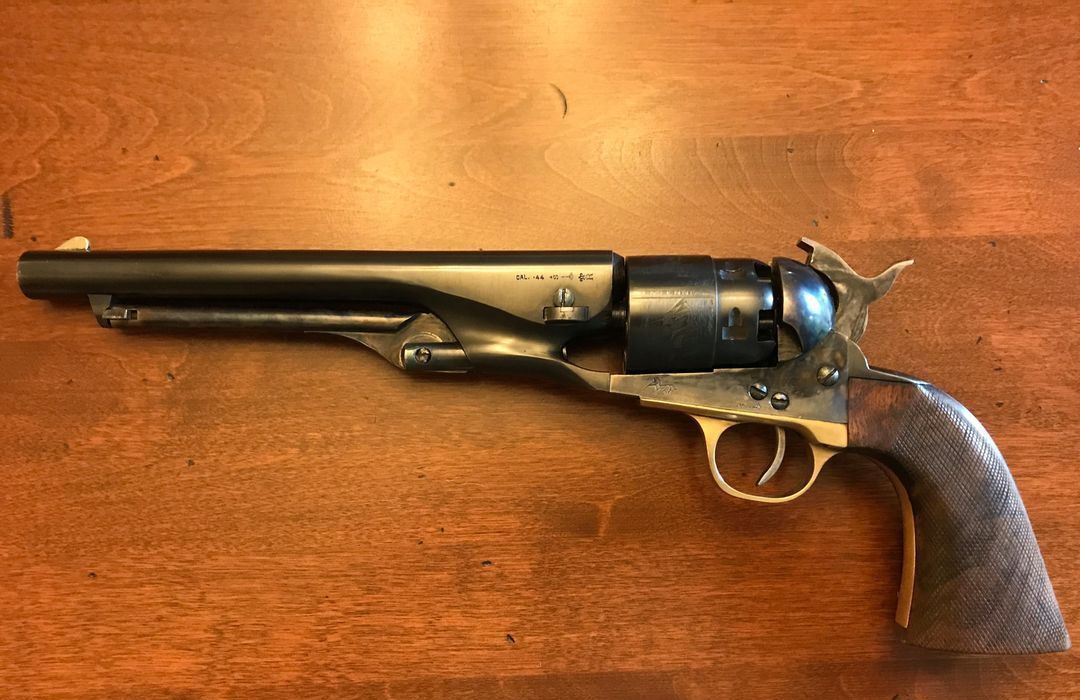
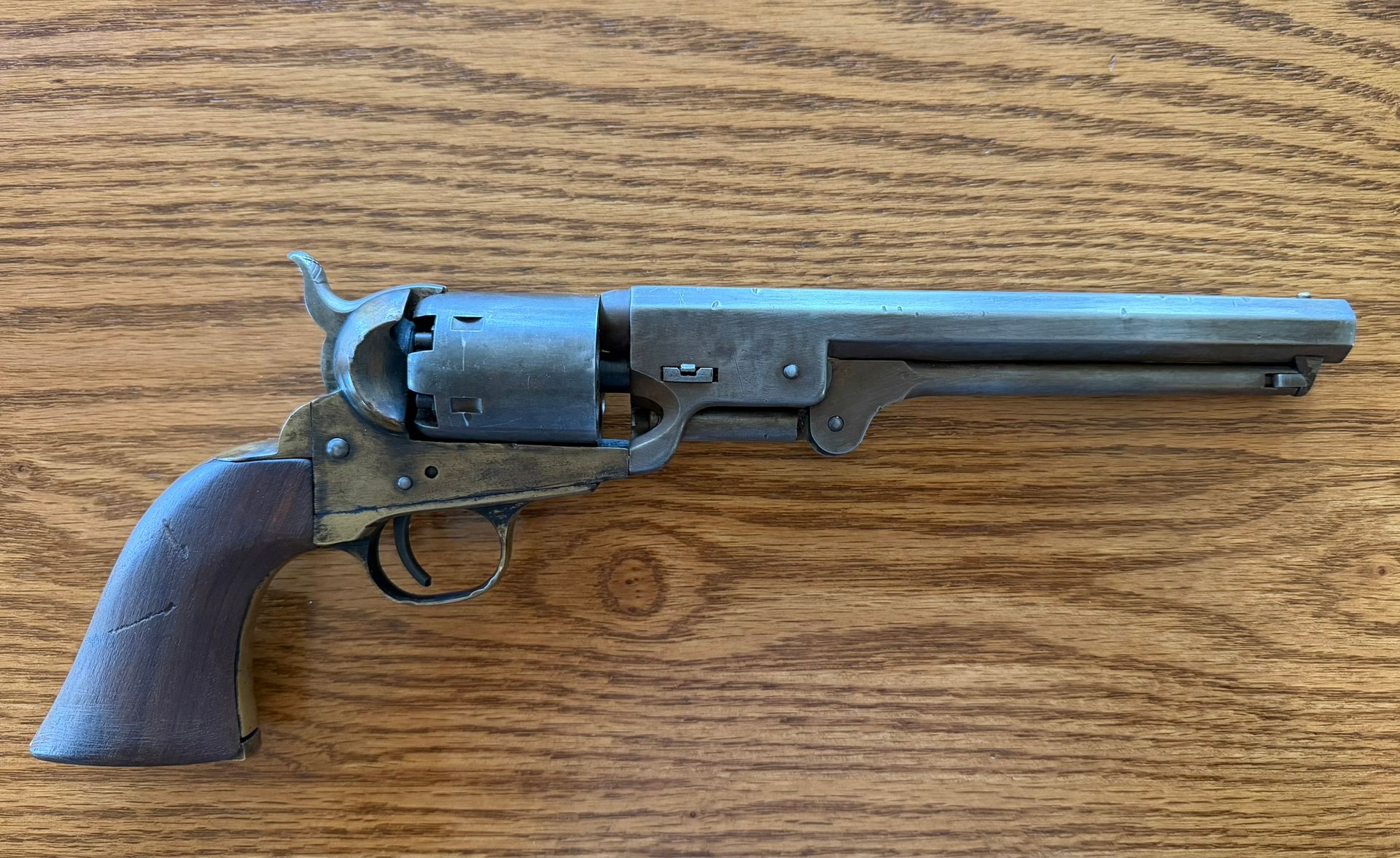
The markings on a replica percussion revolver tell several different stories. Some document official testing. Others identify the manufacturer, the importer, or the business under whose name the revolver was sold. Although collectors sometimes refer to all these inscriptions as “proofmarks,” that usage obscures important distinctions.
The key is function: what does each mark actually establish? A proofmark concerns testing; a maker’s mark concerns manufacturing identity; an importer’s mark concerns the import channel; and a dealer or distributor mark concerns commercial identity. Those functions may overlap, but they should not be treated as interchangeable.
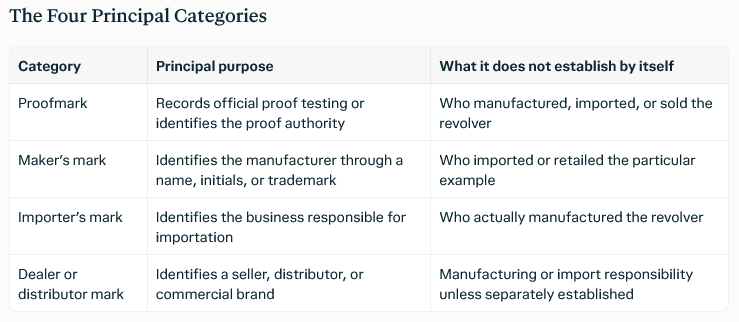
Manufacturer and importer identification are distinct categories in ATF’s firearm-identification guidance. Likewise, Italian proofmark references distinguish official proof stamps and proof-year markings from manufacturing and commercial inscriptions.
Proofmarks: Evidence of Official Testing
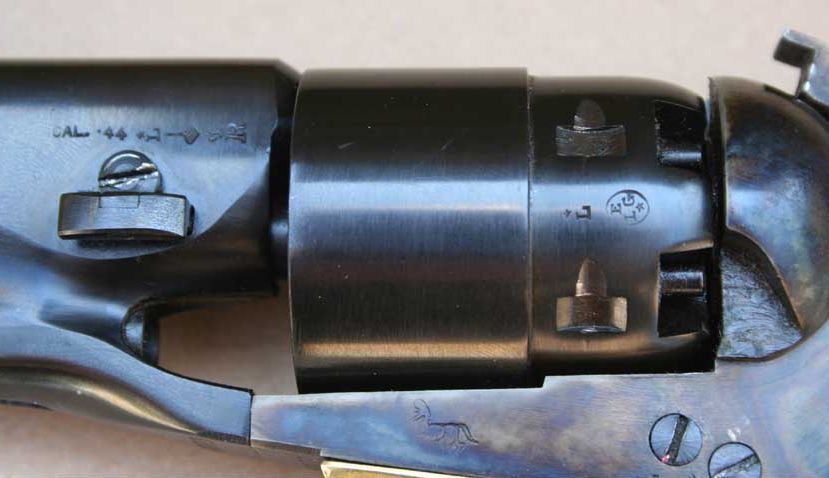
A proofmark records that a firearm or relevant component underwent the prescribed proof process. On Italian reproduction percussion revolvers, the familiar group of small stamps commonly includes a black-powder proofmark, a proof-house identification mark, and a proof-year designation.²
One frequently encountered Italian black-powder proofmark consists of a star within a circle above the letters
PN
. These letters stand for polvere nera, meaning “black powder.” They do not identify Pietta or any other manufacturer.
This distinction is fundamental: an Italian proofmark establishes something about the testing of the arm, not the factory that produced it.
Proof Year Versus Manufacturing Year
The date designation accompanying the proofmarks is properly described as the year of proof. Collectors frequently call it the “manufacturing date,” but that wording goes beyond what the mark itself directly documents.
A proof-year code can be valuable dating evidence. Nevertheless, without additional documentation, it should not be treated as an independently verified assembly, shipment, importation, or retail-sale date. Italian dating references specifically describe these designations as marks identifying the year of testing.
A proofmark also documents a historical event. It is not a current condition report and should not be interpreted as a guarantee that a revolver remains mechanically sound after decades of use, corrosion, alteration, or repair.
Maker’s Marks: Identifying the Manufacturer
A maker’s mark answers the question: “Which manufacturer produced this replica?”
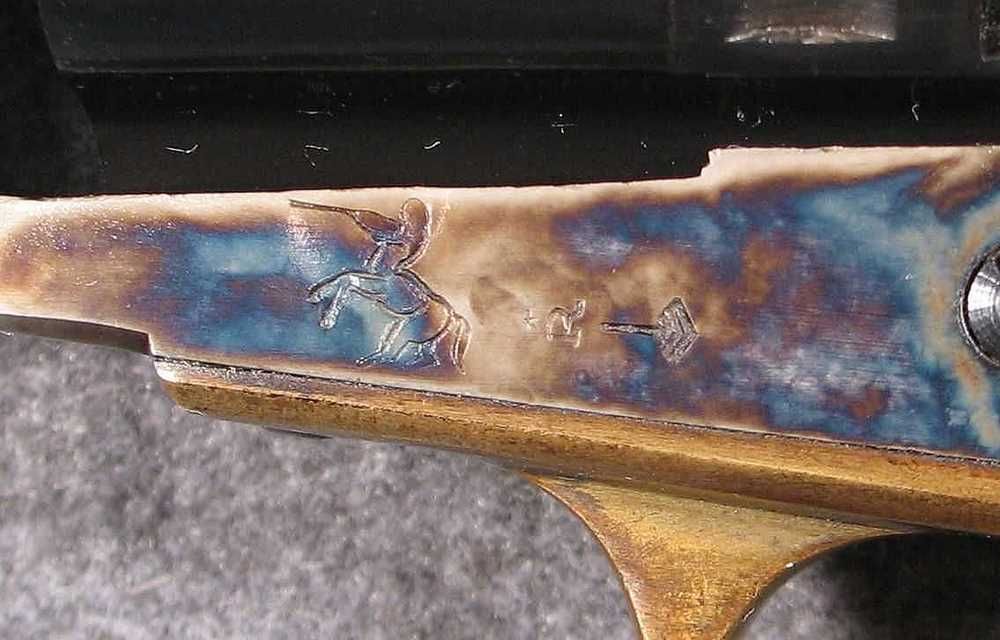
Such a mark may take the form of a full company name, initials, an emblem, or a registered trademark. Pietta revolvers, for example, may carry the name
F.lli Pietta
and the familiar diamond-shaped
FAP
trademark. These identify the manufacturer, whereas the adjacent Italian proof stamps identify testing and proof-house functions.
The distinction becomes especially important when a revolver bears a prominent commercial name on its barrel and a much smaller manufacturer’s mark elsewhere. The largest inscription is not necessarily the best evidence of who made the gun.
Collector identification discussions also note that an importer’s name may provide a useful clue to the manufacturer without conclusively establishing it. A sound attribution therefore separates direct evidence—such as a recognizable maker’s trademark—from an inference based only on the seller’s or importer’s name.
Identifying the maker should not automatically be expanded into a claim that the company manufactured every component in-house. Manufacturer attribution and component sourcing are related but separate questions.
Importer’s Marks: Identifying the Import Channel
An importer’s mark answers a different question: “Which business brought this revolver into the destination country?”
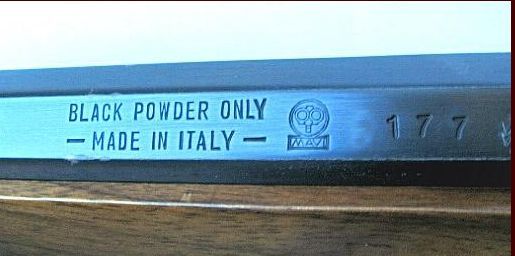
For firearms subject to the applicable U.S. federal marking requirements, ATF distinguishes manufacturer identification from importer identification. Its identification guidance includes the importer’s name and location among the relevant markings on imported firearms.
In replica collecting, Navy Arms illustrates why the distinction matters. Navy Arms imported revolvers from multiple manufacturers, including Uberti and Pietta. Consequently, a Navy Arms inscription alone does not uniquely identify the factory that made a particular revolver.
An attribution such as “Uberti-made, imported by Navy Arms” preserves both identities without confusing their roles. Auction descriptions likewise sometimes identify an example as an Uberti–Navy Arms replica, reflecting the presence of both manufacturing and commercial identities.
A Qualification for U.S. Percussion Replicas
The marking rules applicable to modern cartridge firearms should not automatically be applied to every cap-and-ball replica.
ATF’s guidance and regulatory definitions exclude qualifying antique firearms and qualifying replicas from the Gun Control Act’s definition of a firearm, subject to specified conditions and exceptions.⁸ A commercial importer inscription on a percussion replica therefore should not automatically be labeled a legally required Gun Control Act import mark merely because it resembles one found on a modern cartridge firearm.
The legal requirement and the commercial meaning of the inscription are separate issues. A name may identify an importer even when a particular modern-firearm marking requirement does not apply.
Dealer and Distributor Marks: Identifying the Commercial Brand
A dealer’s mark answers: “Under whose name was this revolver marketed or sold?”
In collector usage, “dealer mark” may refer to a retailer’s name, a distributor’s brand, or a private-label inscription. Unlike an official proofmark, it describes a commercial association rather than a testing certification.
The term can be imprecise because the business named on the revolver may have performed several roles. A company might have been an importer and wholesaler, an importer and retailer, or a distributor selling firearms obtained through another importer.
For this reason, “commercial brand marking,” “retailer marking,” or “distributor marking” may be more accurate than “dealer mark” when the company’s precise role has not been documented.
Three distinctions help prevent misidentification:
- Selling a revolver does not establish that the seller manufactured it.
- Having a commercial name applied at the factory does not make that business the manufacturer.
- A business can be both importer and seller, so those descriptions are not necessarily mutually exclusive.
These terms should describe the company’s documented role in relation to the particular revolver, rather than a role inferred solely from the appearance or prominence of its name.
Why One Revolver Can Carry Several Different Names
Multiple names on a replica are not necessarily contradictory. They may document successive stages in the arm’s history:
- A manufacturer produced the revolver.
- A proof authority tested it and applied the appropriate marks.
- An importer brought it into another country.
- A distributor or retailer marketed it under a commercial name.
Some of these roles may have been performed by the same business. Others may have involved separate companies. The distinction between Uberti manufacture and Navy Arms importation is one example of why both names can legitimately belong in the description of a single replica.
The correct interpretation therefore depends on the relationship among the marks—not simply on finding the most recognizable name.
A Practical Method for Cataloging Replica Revolvers
A useful catalog entry separates the markings into distinct fields:
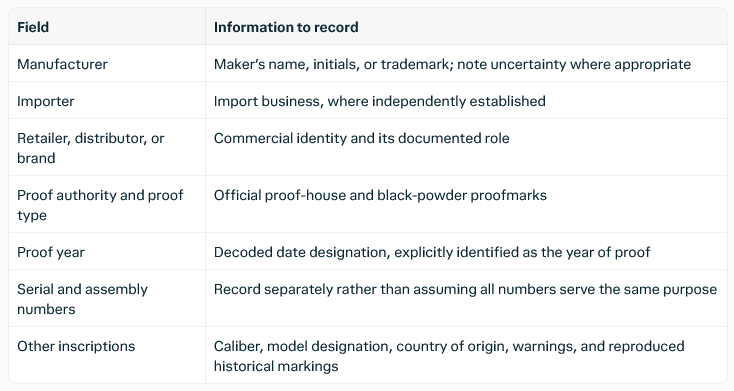
Transcribe the markings as they appear before interpreting them. Then distinguish what the revolver directly shows from what supporting records or comparative research suggest.
This approach produces a more defensible description: the maker identifies manufacturing responsibility, the proofmarks document testing, the importer identifies the import channel, and the commercial inscription identifies the brand or seller.
Sources:
- Bureau of Alcohol, Tobacco, Firearms and Explosives, “Properly Identify a Firearm for the Purpose of Tracing.” Official guidance distinguishing manufacturer, importer, serial-number, and other firearm-identification markings. Its requirements must be read in light of the legal classification of the particular arm.atf
- Cap & Ball Revolvers, “Proofmarks.” Collector reference illustrating and explaining Italian proof-house and black-powder proof markings.capandballrevolvers
- Cap & Ball Revolvers, “Italian Year of Proof Date Codes.” Reference addressing Italian proof-year designations and changes to their format.capandballrevolvers
- The Firing Line, “Newbie Question—I Bought It.” Collector discussion identifying the Pietta name and diamond-shaped
FAPtrademark separately from Italian proofmarks. This is a secondary identification reference rather than an official factory trademark register.thefiringline - The High Road, “How to Identify Makers.” Collector discussion of replica manufacturer identification and the limitations of relying on importer names alone.thehighroad
- Colt Forum, “Navy Arms???” Collector discussion of Navy Arms’ use of multiple manufacturers, including Uberti and Pietta. Useful historical context, but not a substitute for examining the marks on an individual revolver.coltforum
- Bidsquare/Pook & Pook, “Italian Uberti Navy Arms Co. SA Replica Revolver.” Auction description illustrating the separate attribution of manufacturing and commercial identities on an 1851 Navy replica.bidsquare
- Bureau of Alcohol, Tobacco, Firearms and Explosives, “Firearms Questions and Answers,” and 27 CFR § 478.11. Official guidance and definitions relevant to qualifying antique firearms and replicas under the Gun Control Act.
Social Media